Start with what the recipient actually needs
Write down the receiving office, destination country or territory, purpose, exact record, required version and deadline. An apostille authenticates the origin of a public document: its signature, the official capacity and, where appropriate, seal. It does not prove the statements true, create a valid power of attorney or decide foreign admissibility. The Convention covers specified public documents and has exclusions; a diplomatic/consular document or an administrative document dealing directly with commercial or customs operations needs its own scope analysis. A company document is not excluded simply because a business will use it. [HCCH-01; HCCH-02.]
HCCH-01 source
HCCH-02 source
Choose apostille, authentication or an exemption
Check treaty entry into force between the United States and the destination, territorial scope and relevant objections, rather than treating any country in a list as covered. If a rule or agreement dispenses with authentication, an apostille may be unnecessary. A valid Convention apostille ordinarily removes diplomatic/consular legalization; do not add an embassy step automatically. Illinois calls the non-Convention output a Certificate of Authority. Establish that destination’s actual further authentication/legalization requirements before ordering it. The recipient may still specify record age, wording, translation and delivery format. [HCCH-01; HCCH-03; IL-01.]
HCCH-01 source
HCCH-03 source
IL-01 source
Follow the issuing signature rather than your address
Illinois handles eligible Illinois official certifications and Illinois notarial acts. Your current residence and the country from which you mail do not move a New York birth certificate or an FBI report into Illinois jurisdiction. For a public record, identify the office that can issue its certified copy. For a private statement, identify the actual notary and the notary’s commissioning state. A personal statement about a copy is a different public document from the underlying official record; it does not silently replace the requested issuer certification. [IL-01; IL-03; HCCH-01.]
IL-01 source
IL-03 source
HCCH-01 source
Birth certificates: choose the certified version
Use a certified birth record from the eligible county clerk/local registrar or IDPH, not a hospital souvenir, genealogical copy or personal scan. The current IDPH form offers a long form with the most available information ($15 first copy) and a short form ($10); additional copies of the same order are $2 each. Ask the recipient which facts it requires; the short form may not satisfy every authority. A long form is a sensible choice where parentage or a full event record matters, but this guide does not invent a universal long-form apostille rule. [IL-06; IL-07.]
IL-06 source
IL-07 source
Order the birth record before planning the apostille deadline
For IDPH mail orders, complete and sign VR 180, state eligibility and intended use, include the identification evidence specified on page 2, and pay IDPH by check or money order. Send to IDPH Vital Records, 110 West Lawrence Avenue, Springfield IL 62704-2610. The form includes alternatives for expired/no ID and recognizes particular legal representatives; hiring a service does not erase eligibility. Records before 1916 go to the county clerk. IDPH’s checked page warns of approximately 12 weeks for mail requests; compare the county issuer’s current options before assuming state record procurement is fastest. That delay precedes the apostille queue. [IL-06; IL-07.]
IL-06 source
IL-07 source
Death certificates: establish eligibility and legal use
Order a certified legal-use copy from the eligible vital-record issuer. IDPH distinguishes it from an uncertified genealogical copy and limits access to someone with a personal or property-right interest. A nonrelative must provide the requesting office’s supporting letter/document. Its current page also warns of approximately 12 weeks for regular-mail vital requests and identifies the new Lawrence Avenue office. The August 2026 VR 280 form lists the long-form certified record at $19 first copy and $4 each additional, and a short form without cause of death at $10/$2. Choose the facts the recipient needs, then complete/sign VR 280 and include the form’s ID evidence and check/MO payable to IDPH at 110 West Lawrence Avenue, Springfield IL 62704-2610. Do not use the former Ridgley Avenue address. [IL-08; IL-22.]
IL-08 source
IL-22 source
Marriage certificate and state verification are different
Certified Illinois marriage records come from the county clerk where the marriage occurred. IDPH’s $5 service verifies selected facts; it does not supply the county clerk’s certified marriage record. If the recipient asks for the marriage certificate, order that record. A paid verification can be useful for a different stated purpose but is not automatically a cheaper substitute. The SOS page’s broad references to state/local marriage signatures do not change which issuer currently supplies certified copies. [IL-09; IL-03.]
IL-09 source
IL-03 source
Divorce, name change and other court orders
For a divorce decree, order the certified decree from the circuit clerk in the county where the court granted it. IDPH issues a fact verification, not a certified decree. For other orders, identify the court and exact judgment or filing. Illinois’s apostille instructions say not to notarize a circuit clerk’s or circuit judge’s signature; the court record needs the official signature, printed name, title and seal. An attorney’s office copy or a printout from case search is not automatically the required certified court record. [IL-10; IL-01.]
IL-10 source
IL-01 source
Older court records can add a retrieval stage
Cook County’s Archives example illustrates a separate custody problem: noncurrent files may be off-site and require a case number or a paid name/date index search. Its published charges include $6 per year searched, $6 per certified document, plus copying and mailing. Those are Cook Archives charges, not a statewide fee table. Identify the exact case, order and certification before requesting a search. A local helper might assist with an available counter or archive appointment, but cannot eliminate an off-site retrieval or release restriction. [IL-11.]
IL-11 source
School records start with the registrar’s certification
Ask the school records official to certify and sign the transcript or diploma statement before an Illinois notary. Send the original certified/notarized package to SOS. A student’s declaration that a photocopy is accurate is not the same evidence as the registrar’s certification. A transcript sent electronically by a legitimate school can be an authentic school output while still needing different preparation for the physical Illinois apostille process. Request the apostille-ready version before paying for an ordinary transcript download. [IL-01; IL-02.]
IL-01 source
IL-02 source
A university’s bundled route may be useful but is optional
UIUC’s registrar describes verifying/notarizing documents, a county-clerk submission if needed, SOS submission and forwarding. It quotes 3-5 business days for school preparation and a 4-6 week SOS allowance. UIC separately offers a Parchment bundle and quotes 3-7 business days before SOS with a 4-6 week allowance. These are school service descriptions, not the current SOS mail queue. Ask whether the school can instead supply the prepared original for your own submission, what its fee covers and which office owns a return or error. Neither school’s route makes county-clerk certification a universal Illinois requirement. [IL-12; IL-13.]
IL-12 source
IL-13 source
Company status certificates and filed copies answer different questions
A Certificate of Good Standing concerns entity status. A certified copy concerns the particular filing in state custody. A search result or ordinary printout answers neither request automatically. Illinois’s Copy Request page supplies separate corporate, not-for-profit, LLC, LP and LLP forms. Select the entity type and the exact filing; identify amendments if the recipient wants the full formation history. A company affidavit, operating agreement or officer authorization is normally a separate private-document question, not a filed-copy order. [IL-14; IL-15; IL-17.]
IL-14 source
IL-15 source
IL-17 source
Routine corporate records: calculate procurement separately
For business corporations, BCA 15.20 offers a routine Certificate of Good Standing for $25, certified Articles of Incorporation and all amendments for $25, or another specified certified document for $25 per document. It requests the eight-digit file number and NCR payment-account name/number, and allows up to 10 business days. The form’s office is Corporations Division, 501 S. Second Street, Room 330, Springfield IL 62756, with the displayed fax/email and mail/UPS/fax/email return choices. These are company-record procurement arrangements; they do not pay for or complete the later Index Department apostille. [IL-15.]
IL-15 source
Expedited corporate records do not expedite the apostille
BCA 15.15 lists $45 for expedited good standing and $75 for certified articles/all amendments or another certified document. It directs requests to Corporations Division Room 350 and specifies dispatch within 24 hours by the chosen method. A card payment adds the processor charge described on the form. That purchased speed concerns record issuance only. Before selecting email, ask Index whether the particular issued electronic certificate and its proposed paper representation are acceptable; paying for electronic delivery does not settle that question. [IL-16; IL-01.]
IL-16 source
IL-01 source
LLC records have their own form and output choices
LLC 50.25 lists routine good standing or a certified copy for $25, expedited good standing for $45 and expedited certified copies for $75. It requires the payment account rather than mailing card numbers, and names Limited Liability Division, 501 S. Second Street, Room 351, Springfield IL 62756. The checked form states 10 business days routine or 24 hours expedited, with mail/express/fax/email choices. It has an August 2020 header and a February 2026 printing footer; neither is a legal effective date. If the recipient needs original official certification for apostille, choose a suitable issued output rather than assuming any fax or emailed copy will do. [IL-17.]
IL-17 source
Private powers of attorney, affidavits and company statements
Settle the document wording, signer capacity and notarial act before execution. An acknowledgment concerns the signer’s execution; a jurat also requires an oath or affirmation. Illinois’s Basics page requires a notarial certificate and explains when a previously signed acknowledgment is possible. A stamp by itself is not the full act. For an ordinary paper submission, obtain the completed original with the notary’s signature and correct seal/commission information. A local bank, workplace or neighborhood notary can be economical after those requirements are settled; neither low price nor proximity makes that person the foreign legal adviser. [IL-20; IL-05.]
IL-20 source
IL-05 source
Illinois background report: obtain the issuer’s notarized response
First establish whether the recipient wants an Illinois state record, a named local police letter or the FBI national summary. ISP’s Access and Review route uses fingerprints through an Illinois agency/vendor and mails the response; ISP charges no processing fee for Access and Review, but fingerprint providers may charge. If an ISP response needs notarization, its official FAQ says to email BOI Customer Support with the Transaction Control Number (TCN); a notarized copy is then mailed. This is a concrete preparation path, not a reason to have a stranger notarize your downloaded report. Confirm overseas fingerprint arrangements with BOI before buying a service whose output may not fit. [IL-18; IL-19.]
IL-18 source
IL-19 source
An FBI report stays on the federal route
Illinois cannot apostille an FBI Identity History Summary. Use the U.S. Department of State’s federal process for the FBI-issued record. Illinois’s FAQ says to request authentication when ordering the check; this guide does not turn that wording into a universal FBI-order prerequisite. Federal preparation and issuance instructions control the federal route. Notarizing a private declaration about the FBI PDF changes what the state would authenticate and does not provide the requested federal apostille. [IL-03; IL-21; HCCH-01.]
IL-03 source
IL-21 source
HCCH-01 source
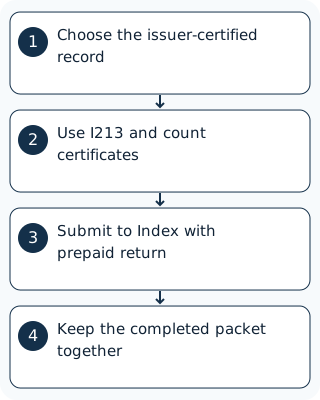
Fill the current I213 application completely
Use the linked Application for Authentication or Apostille, not a generic cover note alone. Select walk-in or mail service; provide requester contact details, any representative details, return method/tracking and the actual country of use. Leave staff-only boxes blank. A person may submit for someone else, but the form’s representative fields do not confer record-access authority or power to sign the underlying document. Obtain enough information to connect any returned packet to the requester. [IL-02.]
IL-02 source
Budget the state certificate fee, then other costs
Illinois charges $2 for each apostille or certificate and requires a separate certificate for each document. Three qualifying documents ordinarily mean $6 in certificate fees, not $2 for the whole envelope and not $2 per page. Add record procurement, any required notarization, translation and delivery separately. The current web procedure asks for one combined check or money order payable to Illinois Secretary of State. I 213 page 2 also mentions credit cards but provides no customer card-authorization fields; check/MO is the common documented route. If card payment matters, ask Index exactly how to authorize it instead of mailing card details. [IL-01; IL-02.]
IL-01 source
IL-02 source
Mail the prepared packet to the current Chicago address
Enclose I 213, eligible originals, correct payment and a prepaid return envelope/label. The current web page and May 2026 form agree on Illinois Secretary of State, Index Department, 160 N. LaSalle Street, Suite 100, Chicago IL 60601. The older I 177 brochure prints 17 N. State Street in Chicago and 111 E. Monroe in Springfield; use the current address, not those legacy locations or the general Secretary of State footer. Courier delivery does not itself buy priority processing. Keep the carrier’s tracking reference distinct from proof that Index accepted the documents. [IL-02; IL-05.]
IL-02 source
IL-05 source
Counter service is a real alternative when the trip makes sense
The current page lists Chicago at 160 N. LaSalle Suite 100 and Springfield at 2701 S. Dirksen Parkway, Springfield IL 62723, plus selected DMV+ locations: Chicago Flagship 125 W. Monroe, Aurora 970 N. Lake Suite B, Champaign 2012 Round Barn, Lake Zurich 951 S. Rand and Melrose Park 1903 N. Mannheim. It says most counter documents are processed while you wait, first come, first served. Verify that the selected office is open and offering the service before travel; a DMV appointment for another service is not proof of apostille availability. You may attend yourself. A paid local submitter can save your trip, but cannot promise issuance on an ineligible document. [IL-01.]
IL-01 source
Read timing as stages rather than a delivery promise
The SOS page checked 2026-10-24 gives 7-14 business days for mail requests; that is not the old brochure’s 7-10 days or the universities’ 4-6 week planning allowance. None includes every stage of issuer procurement, inbound delivery, correction and outbound transport. If you already hold an eligible original and can reach a participating counter, the published while-you-wait route may offer a meaningful advantage. If a birth record still has to be issued or a school has not prepared its certification, a runner at Index cannot solve that upstream delay. [IL-01; IL-05; IL-07; IL-12; IL-13.]
IL-01 source
IL-05 source
IL-07 source
IL-12 source
IL-13 source
Arrange return delivery before sending originals
Provide the prepaid addressed envelope or label and complete I 213 return fields. Illinois’s FAQ describes international forwarding using a prepaid/preprinted FedEx or UPS label. I 213 also lists DHL and other choices; that checkbox does not establish an equivalent pickup arrangement for every office or destination. Resolve the actual return option with the submitting Index office if using a different service. The web page describes first-class return when prepaid postage is absent, while the form instructs you to include prepaid delivery. Follow the complete prepaid route rather than relying on fallback mail. [IL-02; IL-03; IL-01.]
IL-02 source
IL-03 source
IL-01 source
Electronic notarization is not automatically an electronic apostille
Illinois recognizes electronic and remote notarization in its notarial guidance, but the apostille page/form describe originals and physical submission. This research did not establish a current general Illinois electronic-apostille application, issuance or online verification channel. Keep the native signed file and audit information. A personal printout does not automatically preserve an electronic signature or become an issuer-certified original. Before converting, ask Index whether it will authenticate the exact electronic record or require a particular paper certification, who is authorized to make that certification, and what original signature it must bear. Obtain the answer for that actual output before commissioning the act. A domestic recording-copy rule or platform “completed” status is not, by itself, apostille-route approval. [IL-20; IL-02; HCCH-02.]
IL-20 source
IL-02 source
HCCH-02 source
Translations have their own signer and acceptance question
Illinois does not translate records. Its FAQ describes notarizing the translation and authenticating that notary’s authority. That apostille concerns the translator’s notarized statement, not a governmental guarantee that the translation is accurate. Ask the receiving office whether it requires a sworn/local translator, translation of the completed apostille as well as the record, or a separately authenticated translator declaration. The answers determine sequence and cost. Do not notarize the underlying circuit clerk’s signature merely because the completed record also needs translation. [IL-03; IL-01; HCCH-02.]
IL-03 source
IL-01 source
HCCH-02 source
Verify the certificate without confusing verification with acceptance
The Convention requires the issuing authority’s register and verification on request; it does not require a public web lookup. No general Illinois online apostille lookup was established in this review. For a questioned Illinois certificate, give Index the certificate number/date and the official named and ask whether the register entry matches. Do not substitute a notary-commission search for apostille verification. A matching entry confirms issuance, not that the recipient wants this document version or accepts its substantive legal effect. Preserve the complete attached packet for that review. [HCCH-01; HCCH-02; IL-03.]
HCCH-01 source
HCCH-02 source
IL-03 source
If Index returns the request, repair the actual defect
Obtain the stated reason and identify its category: wrong fee or country, missing eligible original, wrong issuer certification, defective notarial certificate or a statutory refusal ground. I 177 lists absent signatures/seals, commission-name/date mismatches and unprepared school records as common causes. For a records defect, request a corrected certified output from its custodian. For a notarial defect, involve the notary and determine whether a new act is needed; the requester should not add a seal or alter the completed certificate. Preserve the return notice and ask Index whether a replacement fee or new application is needed for the proposed resubmission; no universal free-correction policy was found. [IL-04; IL-05.]
IL-04 source
IL-05 source
A recipient’s refusal may require a different repair
A recipient can object to record age, missing facts, document form or translation even when the apostille is genuine. Obtain its written requirement, named reviewing office and specific reason. Compare that requirement with what was ordered; ask whether a new issuer copy, supplemental document or accepted translation will cure it. If the complaint is about the apostille itself, seek issuing-office verification or correction. Do not detach the Illinois certificate, add pages and reattach it: 15 ILCS 305/5.20(c) makes removal or attempted removal invalidate it. A lost or damaged packet needs an office-specific replacement plan, not a recreated certificate. [HCCH-02; IL-04.]
HCCH-02 source
IL-04 source
Worked example: a birth record for a foreign civil registry
Suppose the recipient requests a full Illinois birth record with parent information and a paper apostille. First confirm the treaty route and recipient’s translation/age limits. Order the appropriate certified issuer version, satisfying eligibility and ID. After receipt, submit it with I 213, $2 and prepaid return. No extra notarization of the vital record is the preparation described by Illinois. If you can wait, direct mail avoids a service fee; if time after procurement is short, compare your own counter visit with a local submitter. The $15 IDPH long-form fee plus $2 apostille is $17 before delivery, extra copies or translation, not a total-price promise. [IL-06; IL-07; IL-02; HCCH-01.]
IL-06 source
IL-07 source
IL-02 source
HCCH-01 source
Worked example: company documents for an overseas bank
Suppose a bank separately requires a current good-standing certificate, certified articles and an officer declaration. Confirm the entity type and each document’s required age/output. For an Illinois LLC, the two routine official records are $25 each under LLC 50.25; if separately apostilled, add $2 each. The officer declaration needs its own properly executed notarial route and its own $2 certificate if authenticated in Illinois. Thus $54 for the two official records and their apostilles excludes the declaration, notarization, processor charges and all delivery. Ask whether any optional expedited company-record fee solves the real deadline before buying it. [IL-17; IL-20; IL-02.]
IL-17 source
IL-20 source
IL-02 source
Choose direct submission, local help or a managed service for a reason
Direct official submission is sensible when you can obtain the right original, complete the form, pay and manage return delivery. A local assistant adds value if an available counter saves travel or removes a material mail queue after preparation. Managed help can add document review, coordination across issuers, translation/recipient follow-up and recovery responsibility. Compare the agreed service scope, charges, handoffs and responsibility for rejected or lost originals; a higher price does not prove a faster state queue. You can buy only the missing assistance. None of these options changes issuer eligibility or guarantees the foreign recipient’s acceptance. [IL-01; IL-02; IL-14; HCCH-02.]
IL-01 source
IL-02 source
IL-14 source
HCCH-02 source
Read the dates and the remaining output questions
The source review for this guide was completed on October 24, 2026. A retrieval/check date reports inspection, not when a rule took effect. A form revision date and a statutory amendment’s effective date answer different questions from the date a researcher checked the source. Public sources leave specific questions open: mail card authorization, certain carrier returns, company/court electronic outputs, Illinois electronic apostille capability and replacement/correction fees. Resolve the named issue with the responsible issuer or Index office using the exact document and desired output. The source records below identify the responsible offices and the evidence to use when resolving those questions. [IL-01; IL-02; IL-16; IL-17.]
IL-01 source
IL-02 source
IL-16 source
IL-17 source