Begin with the foreign recipient and the record
Write down the intended country, receiving office, purpose, deadline and exact requested record. Ask whether it needs the full judgment, a certified extract, an original diploma, a school-certified copy or a private declaration; these are different products. Obtain its requirements for record age, translation and paper/electronic delivery. An apostille may be unnecessary where applicable rules or an agreement dispense with authentication, so do not buy one merely because a document crosses a border. This reference explains published Indiana routes and remaining questions; it is not a recipient approval. [HCCH-01: Art. 1; HCCH-02: Art. 3; HCCH-05: status-table notes; HCCH-06: Handbook §§ 21-28.]
HCCH-01 source
HCCH-02 source
HCCH-05 source
HCCH-06 source
Understand what the apostille authenticates
An apostille establishes the origin of the public document: the relevant official signature, the capacity in which the signer acted and, where appropriate, the seal or stamp. It does not establish the truth of an affidavit, ownership of a company, academic equivalence, compliance with foreign law or substantive acceptance. For a notarized private statement, the authenticated public act is the notarization; it does not become the issuing agency’s certification of the underlying record. This is why a notarized photocopy can answer a different question from an issuer-certified copy. [HCCH-03: Art. 5; HCCH-06: Handbook §§ 21-28; IN-03: sample disclaimer.]
HCCH-03 source
HCCH-06 source
IN-03 source
Use the single Indiana certificate without erasing the treaty boundary
Indiana says it adopted a single Model Apostille certificate format July 1, 2022 rather than separate apostille/authentication formats. That is a format change, not universal Hague eligibility. For a destination where the Convention applies, use its simplified origin-authentication route. Outside it, the same Indiana paper may serve an authentication step and further federal or consular work may remain. The current linked sample expressly says it is not a Convention apostille for non-parties. Check the actual U.S./destination relationship, effective dates, objections and territory; HCCH membership alone is not enough. [IN-01: Single Certificate; IN-03: disclaimer; HCCH-01; HCCH-02; HCCH-05.]
IN-01 source
IN-03 source
HCCH-01 source
HCCH-02 source
HCCH-05 source
Separate Indiana, another state and federal origins
The relevant issuer or notarial officer determines the authority, not your current residence or nearest state office. Indiana’s FAQ limits it to Indiana vital records and refuses FBI records; obtain another state’s record through that state’s route. Federal agency records have federal authorities. Federal court clerks can be competent Convention authorities for their court documents: Indiana’s broad federal-court FAQ describes a further federal/embassy legalization chain, which must not replace that separate Hague route without checking the actual destination. Do not submit an out-of-state birth record or FBI result with a private notary stamp as though Indiana were authenticating the original issuer. [IN-01: FAQ, out-of-state vital records, FBI and federal courts; HCCH-01; HCCH-03; HCCH-11: competent-authority directory.]
IN-01 source
HCCH-01 source
HCCH-03 source
HCCH-11 source
Do not order an apostille for domestic use
Indiana’s published instructions and sample exclude use within the United States; the sample expressly includes U.S. territories and possessions. The FAQ specifically addresses Puerto Rico. If a domestic bank, school or office asks for an apostille, identify what certification or signature evidence it actually needs before submitting an ineligible request. An ordinary notary commission check or certified source record may answer that office’s concern; do not promise that either substitutes for whatever substantive evidence it requires. [IN-01: opening restriction and Documents for use in Puerto Rico; IN-03: domestic-use disclaimer; HCCH-01: Art. 1.]
IN-01 source
IN-03 source
HCCH-01 source
Choose the birth-certificate version for its contents
Indiana Department of Health lists both standard and long-form birth certificates as certified. Its table associates long form with apostilles, immigration and dual citizenship and lists additional available details such as time/hospital of birth and parents’ birth dates. Its FAQ says long form must be ordered through the state. The SOS general rule asks for an original or certified copy; the reviewed instructions do not establish that every apostille legally requires long form. If the foreign office needs fields absent from the standard version, order long form; otherwise establish the recipient’s required version rather than assume size or the word apostille alone decides. [IN-07: Types of Birth Certificates table; IN-09: state/county and long-form questions; IN-01: How to Obtain.]
IN-07 source
IN-09 source
IN-01 source
Establish entitlement and identity before a vital-record order
For birth/death records, IDOH requires a qualifying direct interest or relationship and evidence supporting it. The linked two-page identification sheet names eligible applicants and documents: for example an adult sibling’s own birth certificate or a spouse’s marriage proof. It allows one current valid primary picture document, including a U.S. or foreign passport, or two specified current valid secondary documents. Some IDs require front/back copies. Send legible copies of identification; the sheet says originals will not be returned. Religious exceptions have their own clergy-letter and alternative-document route. Do not turn a general relationship label into automatic access to every protected record. [IN-10: PDF pp. 1-2; IN-09: eligibility and religious-exception questions.]
IN-10 source
IN-09 source
Preserve the old-record access exceptions precisely
IDOH’s current FAQ says a non-family birth request may qualify through legal interest or where the event is more than 99 years old. Its identification sheet separately describes a genealogy route for a named person over 75 and deceased, with death proof. Those are different published access statements, not a general rule that all old vital records are public or that every genealogy copy satisfies a foreign authority. Identify the precise record, applicant category and required certified version; if relying on an apparent mismatch, ask IDOH which evidence supports that order before paying. [IN-09: non-family question; IN-10: PDF p. 1 genealogy/relationship list.]
IN-09 source
IN-10 source
Order birth and death records through the correct channel
The state’s Order Certificates page links State Form 49607 for birth and State Form 49606 for death and offers VitalChek as its sole approved online vendor, plus phone ordering. The relevant local health department where the event occurred may sell records in person with its own hours and fees. IDOH itself expressly offers no walk-in service. The ordering page directs mail applicants to the current form for its mailing address; the actual birth/death form downloads were not retrievable in this review, so their editions and address blocks are not newly certified here. Obtain the currently linked form before posting, rather than send a record request to the SOS apostille address. [IN-06: ordering channels and form links; IN-08: Attention Customers.]
IN-06 source
IN-08 source
Separate vital-record procurement charges from the apostille fee
IDOH publishes first birth copy $10 and additional same-order copies $4; first death copy $8 and additional same-order copies $4. Pay its mail charges by check or money order to Indiana Department of Health; it does not accept cash. Its published fees are nonrefundable and exclude vendor/phone service fees and additional UPS charges. Indiana SOS separately exempts birth/death authentication from its filing fee. A zero SOS charge does not make obtaining the record or return delivery free. A local health department’s own price need not equal the state schedule. [IN-06: Order by Mail and Fee Schedule; IN-01: Filing Fees.]
IN-06 source
IN-01 source
Read the conflicting vital-record estimates before setting a deadline
Checked October 25, 2026: IDOH Home asks applicants to allow two weeks for an order to reach the office, then 10-15 business days processing. Its Order Certificates table instead lists standard birth 2-3 weeks, long form 6-8 weeks and death 60 days, subject to case variation. These are different published statements; no current source establishes that the shorter wording supersedes the category-specific table. Use the relevant category and channel, allow for the longer unresolved interval when planning, and obtain current order-specific information if a deadline depends on it. These figures are the record stage, before SOS authentication and delivery. [IN-08: Attention Customers; IN-06: Processing Times table.]
IN-08 source
IN-06 source
Obtain a marriage certificate from the circuit court clerk
For a certified marriage license, IDOH specifically directs the requester to the county Clerk of Court where issued. SOS’s marriage FAQ requires certification by the current circuit court clerk. Follow that specific route rather than its broader Vital Records paragraph grouping marriage with health-office records. Use IDOH’s marriage-search links if you do not know the issuing county, then order the certified license from the clerk; a search result or state Record of Marriage search product is not automatically the same certificate. The Judicial Branch publishes $4 per certified marriage-license copy; confirm the actual clerk’s ordering, payment and return arrangements. [IN-11: certified-copy and unknown-county instructions; IN-01: marriage FAQ; IN-13: §4.]
IN-11 source
IN-01 source
IN-13 source
Order the final divorce decree from the court that entered it
SOS specifically asks for a copy of the final decree from the county where entered; IDOH similarly directs the county where the divorce was issued. The Judicial Branch’s general marriage/divorce paragraph groups both under county of marriage, so do not follow that wording blindly if the divorce happened elsewhere. Find the case court and request an official certified copy in the form needed abroad, including incorporated pages the recipient requires. A MyCase docket entry is not the decree. SOS says marriage/divorce certificates do not need extra notarization; ask the clerk about access, copies, fees and delivery. [IN-01: Divorce Decrees and notarization FAQ; IN-11; IN-12: Marriage or divorce records; IN-26: directory.]
IN-01 source
IN-11 source
IN-12 source
IN-26 source
Treat other court and adoption records as specific public records
For a filed will or estate document, the Judicial Branch directs you to the clerk where the case is heard; transcripts of hearings come through the court reporter. Adoption records are confidential and not ordinary online records, so follow the court/agency access route rather than assume a public search unlocks the order. SOS lists adoption papers among public documents and fee exemptions. Its linked agency explainer distinguishes original/issuer-certified official records from private papers needing notarization; therefore do not add a universal extra notary or county-certification chain to every court record. For an unusual order, identify the exact certifying official and expected signature form before submission. [IN-12: Adoption records, Wills and Other court/case records; IN-05: PDF p. 2; IN-01: Examples of Public Documents and Filing Fees.]
IN-12 source
IN-05 source
IN-01 source
Prepare school records through the school official
Indiana SOS describes the school’s records officer/principal/registrar certifying the authenticity and type of transcript, diploma or degree and signing that statement in a notary’s presence. The notary’s certificate then identifies who signed, where and when, with the notary’s signature, printed name, commission expiration/number and seal. The school official certifies the academic record; the notary attests the signature event; SOS authenticates the notarial signature. A student’s downloaded transcript or a stamp alone does not perform those separate steps. Confirm the foreign institution’s preferred certification method because SOS expressly gives no acceptance guarantee. [IN-01: School Transcripts & Diplomas, required-elements list and example.]
IN-01 source
Use Indiana University’s original-transcript procedure
IU’s current transcript page links a signed apostille request form. The form permits either an original transcript previously requested or an online official transcript order using Signature Request with the required signed authorization page. It expressly refuses copies of PDF transcripts. Include the prepaid addressed return envelope/label and country as directed, and mail the materials to Transcript & Certification Services, ATTN: Transcript Apostille Processing, Indiana University, 420 N Walnut St Room 102, Bloomington, IN 47404. The form is mail-only and excludes walk-ins; named university holds can prevent issuance. Diploma apostille requests go to the campus registrar rather than this transcript form. [IN-14: steps 1-4; IN-15: PDF p. 1, instructions and checkboxes.]
IN-14 source
IN-15 source
Keep university timing separate from SOS timing
IU’s live transcript page says 5-7 business days, while its linked form marked last updated November 6, 2024 says 2-5 business days for its office. Preserve that discrepancy instead of advertising a two-day completed apostille. The same page says the document must then go to Indiana SOS before delivery. Confirm the relevant school-stage estimate when a deadline matters, include any transcript-order or hold-resolution time, then add the state and return stages. A university forwarding service can be useful, but does not turn its preparation estimate into a state promise. [IN-14: timing note; IN-15: PDF p. 1, timing/holds and dated footer; IN-01: processing FAQ.]
IN-14 source
IN-15 source
IN-01 source
Follow Purdue’s own scanned-diploma and forwarding route
Purdue’s current registrar page accepts apostille requests for official transcripts, enrollment/degree certifications and a scanned diploma supplied by the requester. It sends orders placed through National Student Clearinghouse through university preparation to the state in Indianapolis, with return to the recipient address in the order. It publishes 4-6 weeks for the full process and says no expedited processing. This school-specific scanned-diploma route does not authorize a stranger to notarize every scanned record, and IU’s PDF-transcript rule remains different. Purdue Global, Fort Wayne and Northwest have separate registrar instructions. The ordinary $10 transcript price is not established as the all-inclusive apostille order price. [IN-16: Documents for Apostille; Apostille Request and Process; campus exceptions.]
IN-16 source
Choose the actual company record before requesting authentication
Articles and amendments document filings; a Certificate of Existence speaks to an entity’s recorded existence/status; a privately signed resolution or authorization states what its signer asserts. They do not establish the same facts. Indiana’s official navigation provides Print certified copies of business documents through its business search, and dated official FAQs provide a separate newly ordered Certificate of Existence route. Select the entity carefully and the document the foreign recipient actually named. Do not use a plain search summary, an old filing or a private statement merely because each displays the company name. [IN-21: certified-copy navigation; IN-22: existence definition; HCCH-03; HCCH-06.]
IN-21 source
IN-22 source
HCCH-03 source
HCCH-06 source
Order the Certificate of Existence through its own official path
Indiana’s February 25, 2023 FAQ directs INBiz account holders to Online Services, Secretary of State, Orders, Certificate of Existence. Its May 4, 2023 FAQ says to select the business, pay and receive the new certificate by email or through the dashboard Documents widget. Those dated official instructions are an actionable starting route, not proof of an unchanged current screen or price: INBiz and the public business search returned 503 to retrieval, and no order was placed. The amount for a new existence certificate is not verified here. Inspect the actual charge/output before paying, independently of any copies of already-filed records. [IN-22: ordering paragraph; IN-23: steps and delivery; IN-21: portal navigation/access limit.]
IN-22 source
IN-23 source
IN-21 source
Do not add a private notarization to an official company certificate by reflex
The current linked agency explainer says records already issued and signed by a public official are distinct from private documents needing notarization, and additionally lists documents prepared by SOS as fee-exempt. That is more specific than the main FAQ’s broad any other documents need notarization sentence. Use the actual SOS-certified output and identify its official signature. The reviewed public material does not settle every printed electronic corporate certificate: establish its original/certified status and the state’s accepted presentation before printing, reformatting or adding a copy statement. An apostille on a director’s private authorization authenticates its notarial act, not the state’s company register. [IN-05: PDF p. 2, steps 1, 3 and 4; IN-01: notarization FAQ; IN-21; HCCH-03.]
IN-05 source
IN-01 source
IN-21 source
HCCH-03 source
Complete the notarial act the private document actually requires
For a power of attorney, consent, affidavit or private company statement, establish whether the required act is an acknowledgment, an oath-based verification, signature witnessing or another authorized act before the session. They attest different events; a signature-plus-stamp alone is not a full certificate. SOS’s current page requires a properly completed certificate describing the jurisdiction, date, signer and attested facts, with signature/seal. Its 2024 training says the notary should not choose or substitute the act for the requester. If the document’s wording is missing or asks for powers beyond the notary’s role, obtain instructions from its author/recipient rather than silently change its legal purpose. [IN-01: Notarized Documents; IN-24: PDF p. 6, Notary Certificates; HCCH-03.]
IN-01 source
IN-24 source
HCCH-03 source
Distinguish record-copy authentication from a copy statement
An accurate private statement about a copy may be notarized, but an apostille on that act does not directly certify the source issuer’s signature or turn the statement into an official birth, death, court or company record. Indiana’s current agency guidance asks for originals or issuer-certified copies and warns against photocopies/scans as the document being authenticated; school and corporate output exceptions must be followed in their proper category. The current full Notary Guide was inaccessible, so this guide does not newly qualify a general Indiana direct-copy-certification power from search snippets. Ask which exact document and signature the recipient needs before paying for an alternative. [IN-05: PDF p. 2, Check that Documents are Ready; IN-01: original/certified requirement; IN-25: access limit; HCCH-03; HCCH-06.]
IN-05 source
IN-01 source
IN-25 source
HCCH-03 source
HCCH-06 source
Ask for the right background check before buying one
ISP says its Limited Criminal History is an Indiana-only name/date-of-birth product containing Indiana felony and misdemeanor arrest information, dependent on county participation. It may return On File, Inconclusive or No Records Found. That is not a national fingerprint result, an FBI Identity History Summary or a complete court record. The Judicial Branch warns MyCase is not a complete criminal-history search. Ask the recipient which geography, search method and official response it needs before ordering; a perfectly authentic document of the wrong scope remains the wrong document. [IN-17: Services.IN.gov:Limited Criminal History; IN-12: Criminal history; IN-01: FBI FAQ.]
IN-17 source
IN-12 source
IN-01 source
Use ISP’s current mail payment instruction and preserve its source conflict
The current ISP page links Form 8053 and directs mailed Limited Criminal History requests with a money order payable State of Indiana to Indiana State Police, Criminal History Limited Check, PO Box 6188, Indianapolis, IN 46206-6188. Its fee table publishes $7 by mail and $16.32 online. The linked two-page form is R11/4-14 and contains older certified-check/money order and in-person wording that differs from the current money order-only mail instruction. Follow the current narrower mail guidance, not a personal check or the contradictory old sentence. The older online-service landing publishes $15/$15.70 instead; inspect the official checkout total rather than treat either conflicting page as a paid receipt. [IN-17: mail paragraph; IN-18: State-Only Limited Criminal History table; IN-19: PDF pp. 1-2; IN-20: Online Fee.]
IN-17 source
IN-18 source
IN-19 source
IN-20 source
Confirm the export-ready police output rather than assume a PDF qualifies
The retrieved ISP pages/Form 8053 do not establish a specific notarized or official-signature export-response ordering procedure. The older online landing says it supplies a PDF, mails no copy and makes that download available for 14 days; that is a retrieval window, not an apostille expiry. Before paying for a record intended for SOS, identify whether ISP will supply the original official signature/seal or an appropriately notarized response and whether the recipient accepts that product. No universal rule in this guide declares every police download eligible or ineligible. An FBI result follows federal authentication, and an Indiana notarial cover statement authenticates only that separate act. [IN-17; IN-19: form fields; IN-20: Important Notice; IN-01: Notarized Documents and FBI FAQ; HCCH-03.]
IN-17 source
IN-19 source
IN-20 source
IN-01 source
HCCH-03 source
Separate electronic notarization, remote notarization and e-Apostille
The 2024 Indiana agency training distinguishes an electronic record signed in a physical meeting from electronic remote notarization through an approved platform; it describes additional remote-certificate location information and rejects ordinary remote-ink/paper video workarounds. These are notarization issues, not evidence that Indiana issues e-Apostilles. Current authentication instructions publish original/certified-copy mail and counter channels; no complete public electronic submission/output route was established in this review. Keep the signed electronic file and ask about its precise accepted presentation instead of assuming a home printout, an emailed scan or a provider marketing claim decides eligibility. Absence of a proven channel is not a universal conversion ban. [IN-24: PDF pp. 8-9 and 12; IN-01: submission channels; HCCH-10: Handbook §§ 154-156 and 215-220.]
IN-24 source
IN-01 source
HCCH-10 source
Treat translation as its own record and recipient question
Indiana SOS does not translate. Its FAQ says the translation must be notarized before its office processes an authentication request; the funeral/coroner explainer separately says a notarized translation may be needed and directs attention to the receiving country. Establish whether the foreign office wants an official/sworn translator, a translator’s statement, a translation of the apostille itself, and what must be attached. Notarization authenticates the translator’s signature or oath as described in that certificate; the apostille does not check linguistic accuracy. If the exact foreign-language record/category is unclear, resolve that form question before altering the original or purchasing a generic translation package. [IN-01: translation FAQ; IN-05: PDF p. 4; HCCH-09: Handbook §§ 186-188; HCCH-03.]
IN-01 source
IN-05 source
HCCH-09 source
HCCH-03 source
Use the current request form and describe the order clearly
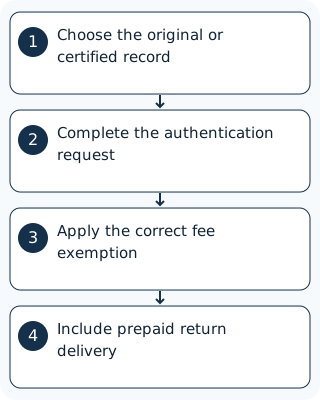
Start from SOS’s Authentication Request Form link rather than an old vendor-hosted copy. The current page requires completing the form, naming the destination country and submitting the original/certified document; calculate the correct fee and provide the addressed prepaid return. The full linked State Form 56720 returned 403 during research, so its current revision and every field were not inspected; this is an access limit, not proof that the form is unavailable to you. Read the downloaded version’s own checklist before sending. The funeral/coroner explainer allows a cover letter containing required information in that context; it is not a basis to invent an unrelated incomplete-form shortcut. [IN-01: How to Obtain; IN-02: link/access limit; IN-05: PDF p. 2, Complete the Request Form.]
IN-01 source
IN-02 source
IN-05 source
Count authentications and fee exemptions rather than pages
SOS publishes $2 per authentication, not per page. Its current main page exempts birth/death certificates, adoption documents and student transcripts/diplomas. Its current linked 2025 agency explainer additionally lists documents prepared by Secretary of State. An omitted fourth category in a shorter list is not proof a charge is required; identify the exact official document and apply the more specific published guidance, confirming if the classification is disputed. A privately drafted document is not automatically exempt because a school, adoption or company is mentioned in it. Separate issuer/record, notary, translation and return-postage costs from this state fee. [IN-01: Filing Fees; IN-05: PDF p. 2, Payment of Fees.]
IN-01 source
IN-05 source
Match the payment method to the submission channel
For mail, SOS directs check or money order; its current linked explainer makes checks payable Secretary of State. For an office visit, the main page permits credit, debit, check or money order upon arrival. Do not put card details on an improvised cover letter or assume the same online payment route as a business filing. Keep IDOH checks payable Indiana Department of Health and ISP mail money orders payable State of Indiana in their own record-procurement orders. The request-form text could not be fully retrieved, so no new refund/overpayment assurance is made. [IN-01: In Person, Mail and fee FAQ; IN-05: PDF p. 2; IN-06: Fee Schedule; IN-17: mail paragraph; IN-02: access limit.]
IN-01 source
IN-05 source
IN-06 source
IN-17 source
IN-02 source
Send the authentication request to the one SOS office
The published authentication address is Indiana Secretary of State, Authentications, 302 W. Washington Street, Room E-018, Indianapolis, IN 46204. Include the completed current request, eligible documents, payment where applicable and self-addressed stamped/prepaid return. The agency explainer permits mail or courier to this street address. SOS says it has no branch offices; a motor-vehicle branch is not an authentication counter. Keep record-procurement addresses distinct: a birth application goes to the address on the IDOH form, an IU transcript order to IU, and an ISP mail check to ISP. A faster carrier cannot supply a missing certification. [IN-01: Mail and address/branch FAQ; IN-04: Mailing address; IN-05: PDF p. 3.]
IN-01 source
IN-04 source
IN-05 source
Choose a counter visit with the actual quantity thresholds
Current SOS instructions say an appointment allows up to 10 documents processed while you wait; without one, up to 5. For more than those limits, follow the appointment/prepaid-return instructions instead of assuming an agent can bypass them. Requests above 30 may need additional time. The general contact page publishes Monday-Friday, 8 a.m.-4:30 p.m. and walk-in service with appointment priority; check holidays and current notice before travel. Its current appointment link is on the authentication/contact pages. The funeral brochure’s fewer-than-5 wording differs at exactly 5; the current main page expressly says up to 5 and is used here. [IN-01: In Person Processing Times; IN-04: Hours; IN-05: PDF p. 3.]
IN-01 source
IN-04 source
IN-05 source
Use the dated processing estimate for the correct stage
Checked October 25, 2026: SOS’s FAQ says normally 1-2 business days from receipt. For counter-delivered work requiring return, the main page says documents received by noon are mailed the next business day, after noon within two business days, and above 30 may take longer. This is a published handling estimate, not a delivery promise or proof that every packet is accepted. Procurement, notary/school preparation, holidays, corrections and outbound delivery add time. The current linked funeral explainer says same-day is typical but not guaranteed; urgency can be explained to the office but does not create an entitlement or purchased state priority. [IN-01: processing FAQ and In Person Processing Times; IN-05: PDF p. 3, Turnaround Time.]
IN-01 source
IN-05 source
Plan the return before sending a one-way packet
SOS’s ordinary mail instructions require a self-addressed stamped envelope; for overnight return include a prepaid pre-addressed airbill. Its agency explainer recommends tracked inbound and return services. If you are abroad, confirm that the chosen prepaid service and address can actually be used by the office; a domestic stamp is not an international courier label. The full current request form’s international-return clause was not inspected, so do not infer a universal free overseas return or a specific carrier account arrangement. Retain delivery information and distinguish a carrier delivery scan from the office’s acceptance of the documents. [IN-01: Mail; IN-05: PDF p. 3; IN-02: access limit.]
IN-01 source
IN-05 source
IN-02 source
Verify the certificate through its issuer
The current linked Indiana sample contains the ten numbered fields and a unique certificate number; its footer directs issuance verification by email to INBiz@sos.in.gov. Supply certificate identifiers and the specific concern to that official channel using the authority’s current instructions; HCCH Art. 7 requires issuer-register verification. No live certificate lookup was performed, and no public searchable Indiana apostille register was established here. Indiana’s separate notary search can establish commission information, not that a particular apostille was issued. A blue seal or trilingual layout may match published standards but is not by itself proof against forgery. [IN-03: PDF p. 1, fields and verification footer; IN-01: Certificate Standards and Puerto Rico/notary search; HCCH-04: Art. 7.]
IN-03 source
IN-01 source
HCCH-04 source
Keep the authentication attached and the document unchanged
SOS says removing its certificate invalidates the authentication. Its FAQ says you cannot detach it, add a page and reattach; the additional page may need its own authentication or the whole package may need resubmission. Published standards attach the certificate to the front of the page bearing the certified signature/seal with two left-side staples; this describes the official output, not permission to reconstruct it. Preserve the complete original packet or original electronic association. A scan is useful for review but does not automatically satisfy the recipient’s need for an intact paper record or become an e-Apostille. [IN-01: Certificate Standards and added-page FAQ; HCCH-07: Handbook §§ 245-251.]
IN-01 source
HCCH-07 source
Recover from the specific defect at its source
If the packet is returned, retain the written reason and identify whether the problem is issuer eligibility, missing certification, incomplete notarial wording, wrong fee, country, form, translation or return arrangements. Obtain a corrected/reissued record from its custodian or have the responsible notary correct/reperform the act under applicable rules; do not change another official’s completed certification yourself. Check whether the rejected version must accompany a new submission and whether any new fee applies; no blanket refund, rework waiver or guaranteed reissue was established. If the foreign recipient refuses it, obtain that office’s exact written reason so a substantive-record objection is not mistaken for an origin-authentication defect. [IN-01: original/certified and certificate requirements; IN-10: returned IDOH requests; IN-15: school holds/PDF exclusion; HCCH-08: Handbook §§ 257-264; HCCH-06.]
IN-01 source
IN-10 source
IN-15 source
HCCH-08 source
HCCH-06 source
Use the special funeral guidance without promising release or transport
Indiana’s current linked funeral/coroner explainer discusses death certificates, coroner reports, burial transit permits, non-contagion letters and related notarized statements. These are different documents, not a single death-certificate packet for every country. It asks applicants to identify urgency and notes staff can review documents in advance. The foreign authority and carrier may require other permissions; an apostille does not itself authorize transport of remains. Use the applicable official record and signature for each item and document the recipient’s actual list. The guide’s general fee/preparation advice is useful, but its urgent context is not a guaranteed fast lane for unrelated orders. [IN-05: PDF pp. 1-4; IN-01: Funeral homes and burial transit paperwork; HCCH-03; HCCH-06.]
IN-05 source
IN-01 source
HCCH-03 source
HCCH-06 source
Compare direct, local and optional managed help honestly
If you already hold the correct certified Indiana record and can manage mail/return, the official direct route may be enough. An office visit can address an eligible small packet under the published quantity limits; a school’s own forwarding service may avoid unnecessary handling steps. For simple wet-ink private documents, the state explainer points to banks/credit unions and pack-and-ship notaries; availability and price vary, and SOS says it does not provide notary service. Optional Notary Geek help can cover a defined review, notarial act, physical handling or a managed order after acceptance and pricing are agreed. It is not a state requirement and confers no special authority, guaranteed priority or recipient approval. [IN-01: official channels; IN-05: PDF pp. 3-4; IN-14; IN-16. Comparison is original Notary Geek explanatory analysis.]
IN-01 source
IN-05 source
IN-14 source
IN-16 source
Worked example: a certified birth record and a short deadline
Fictional example: Morgan needs parents’ birth dates shown for a foreign registry. A standard Indiana birth certificate may omit those additional details, so Morgan first checks the written requirement and orders the state long form with eligibility/ID evidence. The state record charge starts at $10; the SOS birth authentication fee is exempt, but postage/vendor charges may remain. The published long-form 6-8 week estimate and conflicting general IDOH notice must be addressed before relying on a deadline. SOS’s normal 1-2 days does not shorten the earlier record stage. Morgan submits the proper record through the published SOS route only after obtaining it; no paid intermediary is inherently required. [IN-07; IN-09; IN-10; IN-06; IN-08; IN-01.]
IN-07 source
IN-09 source
IN-10 source
IN-06 source
IN-08 source
IN-01 source
Worked example: a transcript and a separate private authorization
Fictional example: Asha needs an IU transcript and a personally signed authorization. IU will not notarize a printed copy of its PDF transcript; Asha uses its original/Signature Request route and signed form instead. The authorization separately needs the recipient’s specified notarial act. Assuming one authentication for each, the student transcript is SOS fee-exempt and the ordinary private authorization would be $2; notarial charges, school procurement and delivery remain separate. IU’s preparation plus SOS plus return must all fit the deadline. Combining the two documents does not make the private authorization exempt or turn its declaration into a university record. [IN-15: PDF p. 1; IN-14; IN-01: School Transcripts & Diplomas and Filing Fees.]
IN-15 source
IN-14 source
IN-01 source
Worked example: a company record and an FBI result
Fictional example: an Indiana company is asked for proof of existence and its owner’s FBI check. The company obtains the actual state Certificate of Existence through the official order path and checks its certified-output presentation; it does not substitute a director’s statement or a plain entity-search result. The FBI record has a federal origin and is not eligible merely because the owner lives in Indiana. The state certificate fee/exemption question, any private authorization and federal authentication are separate routes. No amount of bundling gives Indiana SOS authority to authenticate the FBI issuer. [IN-22; IN-23; IN-05: PDF p. 2; IN-01: FBI FAQ; HCCH-03; HCCH-11.]
IN-22 source
IN-23 source
IN-05 source
IN-01 source
HCCH-03 source
HCCH-11 source