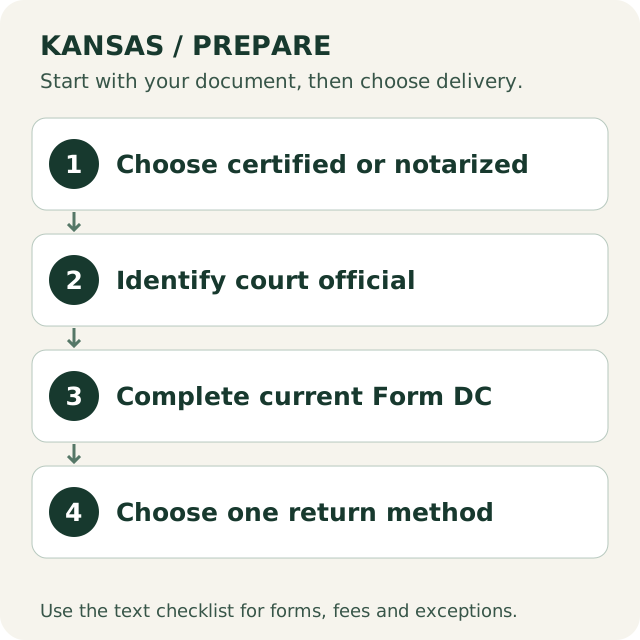
Identify what the foreign recipient actually needs
Write down the document, issuing authority, country/territory, recipient, acceptable age, language and whether the recipient requires an original, issuer-certified copy or notarized private statement. An apostille verifies the public signature, capacity and seal; it does not approve the facts or guarantee the recipient will accept the document. Check the HCCH table for entry into force, territorial extension and objections applicable between the origin and destination; being listed alone is insufficient. For a Convention route, do not add embassy legalization automatically. For a non-Convention route, obtain that destination authority’s written authentication/legalization sequence. [HCCH-01: Arts.1-5,9,12; HCCH-02: EIF/EXT/objections.]
HCCH-01 source
HCCH-02 source
Choose Kansas only for the signature Kansas can authenticate
Kansas SOS authenticates Kansas public officials and Kansas notaries. Your residence or mailing location does not move a Missouri birth record into Kansas. A private document notarized by a Florida notary follows the Florida notary-signature route even if its signer lives in Kansas. A foreign-issued record coming into Kansas normally follows its country of origin’s competent authority; translating it in Kansas does not change its origin. A Kansas-notarized translator’s declaration, if required, is a separate notarial document. [KS-01: Information and document categories; HCCH-01: Arts.1,3,6. Origin examples are practical application.]
KS-01 source
HCCH-01 source
Separate official records from private signatures
For birth, death, marriage, filed company and court records, get the record from its official custodian. Do not ask a local notary to certify your photocopy of those public records. A notarized cover letter or custodian affidavit authenticates that private act, not the underlying public official’s record. Private affidavits, powers of attorney and company resolutions may need the appropriate notarial act; they are different from the company’s filed articles or good-standing certificate. [KS-15: printed pp.5-6,21-22.]
KS-15 source
Order Kansas vital records directly
Use the linked KDHE birth, death, marriage or divorce application for the exact record; select the required copies, describe the specific foreign-use purpose, supply event details, relationship and contact/return address, and sign the request. Include readable front and back of current qualifying ID and any proof of direct interest/guardianship. These records are restricted, not available to any paid runner simply because it is a runner. The application reverse lists eligibility and alternatives when photo ID is unavailable. A hospital keepsake, scan or ordinary photocopy is not an issuer-certified copy. [KS-05 through KS-08: pp.1-2.]
KS-05 source
KS-08 source
Pay KDHE and address the record request
The mail charge is $20 per certified copy, paid by U.S.-dollar check or money order to Kansas Vital Statistics. Include a business-size self-addressed stamped envelope for each different record request. Mail to Office of Vital Statistics, Curtis State Office Building, 1000 SW Jackson, Suite 120, Topeka KS 66612-2221. For priority return, include a prepaid self-addressed priority envelope; an account number or money for KDHE to buy postage is insufficient. Initial fees cover a five-year search and are retained if no record is found. Different records can be handled/mailed separately; birth-form fees expire 12 months after request. KDHE payment does not pay SOS. [KS-04: Costs, Submitting Requests and Priority Mail; KS-05: p.2 footnotes.]
KS-04 source
KS-05 source
Compare vital-record speed before paying extra
KDHE’s birth table estimates regular/priority-mail processing at 7-10 business days; internet/telephone orders at 3-5 business days after receipt cost $20 plus $15 expedited-service fee. Its 9 a.m.-4 p.m. Monday-Friday walk-in service lists $20 and around 15-20 minutes if the record is located without difficulty. IKAN’s $5 fee buys a separate ordering option: wait for the will-call readiness message; only the applicant with current government photo ID may collect. These are birth-record procurement estimates, before SOS and shipping. They are not apostille expedited lanes. Check each other record’s current ordering page rather than transferring birth timing to it. [KS-03: ordering table.]
KS-03 source
Distinguish divorce certificate, decree and no-marriage evidence
KDHE’s divorce certificate contains basic facts; it does not contain the settlement decree. Order a certified decree from the District Court clerk in the county of filing if that is what the recipient asks for. SOS’s broad vital-office link for divorce decrees does not override KDHE’s explicit distinction. For a Kansas verification-of-no-marriage letter, use the marriage request form, explicitly request that letter and identify the search years; each five-year span costs $20. Otherwise KDHE warns it may send an ordinary no-record-found letter. The search does not prove worldwide single status. [KS-09: introduction; KS-10: request instructions.]
KS-09 source
KS-10 source
Prepare court records for signature verification
Ask the court holding the case for a certified copy of the exact judgment, divorce decree or name-change order. Give case number, party names, filing date/title and foreign-use purpose; request the signing clerk/deputy’s printed name and title. Put that official’s name in Form DC section 2; SOS says the signature must be on file. A docket printout is not automatically a certified judgment. Ask the clerk for the copy, certification, search/access and delivery total and payment instructions before ordering; the Judicial Branch’s general record-request page is a starting locator, not one fee for every district court. Electronic certification and unusual officials require SOS confirmation on the exact output. [KS-01: court footnote; KS-02: section 2; KS-11: custodians/copy costs.]
KS-01 source
KS-02 source
KS-11 source
Obtain the right company certificate or filing
Use SOS Copies & Certifications: log in/create the required account, select Purchase Certified Copy/Certificate of Good Standing Search, find the entity by name or KansasID, select it and choose the required certified filing or CGS. Free file-stamped copies lack the purchased certification. A CGS describes status with SOS; it is not a tax clearance, and SOS holds no tax documents. The purchased copy bears certification on each page and a verification code; save it from Completed Filings (available up to 1 year). For apostille handling, confirm the printed/electronic output SOS requires before mailing. [KS-12: certified copies, CGS, purchasing and verification.]
KS-12 source
Do not rely on the stale combined business form
The retained January 2024 Form CO lists $35 certified copies,$15 CGS and a combined apostille checkbox, but still shows $7.50 and the old Memorial Hall address; the current business page says certified copies are exclusively online. Published February 2026 fee rules retain additive components: a corporate certified copy has $15 under 7-34-2 plus $15 under 7-16-1 plus $5 under 7-16-2; CGS has $5+$5+$5. These support $35/$15 procurement budgets, but are not a tested portal quote. Use current online procurement, then current Form DC for the ordinary separate apostille; ask SOS to resolve a combined-order or unusual entity/output rather than mail the stale form unquestioningly. [KS-13: pp.1-2; KS-17: PDF pp.71-76; KS-12.]
KS-13 source
KS-17 source
KS-12 source
Use the school’s official notarization process
For Kansas State University, order a new official transcript or duplicate diploma, mark For Apostille Processing, pay the registrar certification fee and complete its linked Apostille Request Form. K-State notarizes only new official documents, not old diplomas/unofficial copies; it mails the prepared documents back, and you submit them to SOS yourself. The posted university processing allowance is 4-6 weeks. Its table lists transcript $15, duplicate diploma $25, certification $15 covering one of each, and $5 additional course-description/syllabus certification. Keep the university fee separate from SOS’s charge per document. Other Kansas schools set their own registrar process and prices. [KS-14: Notarization Services, steps 1-4, Final Submission, timeline/fees.]
KS-14 source
Check a private notarization before submitting
Choose the required acknowledgment, oath/verification or signature-witnessing act using the recipient’s written requirement and appropriate advice before the appointment. The certificate must identify the act, venue/date, notary signature/title, stamp and commission expiry as applicable; a bare signature/stamp is insufficient. An acknowledgment differs from an oath or a witnessed signature. Have the notary correct its certificate properly; do not edit a completed notarization yourself. A foreign-language document can be eligible when its notarization is in English. [KS-15: printed pp.7-10,22-24; KS-01: document categories.]
KS-15 source
KS-01 source
Treat remote notarization and apostille output separately
Kansas permits RON by a properly authorized Kansas notary physically in Kansas. A signer abroad also raises the U.S.-connection and foreign-prohibition conditions described in the handbook; RON availability does not mean any overseas document qualifies. Neither an electronic notarization, emailed scan nor home printout proves Kansas will issue a true e-Apostille or accept that particular paper conversion. No Kansas electronic-apostille issuance/print-conversion procedure was verified here: obtain SOS’s written instructions for the actual electronic original before buying RON or printing it. Use the ordinary compliant paper route when appropriate. [KS-16: Remote Online Notarizations; KS-15: printed pp.20-21.]
KS-16 source
KS-15 source
Use current Form DC and count documents
Download the official June 17,2026 Form DC. Fill requester/contact/return details in section 1; court official if applicable in 2; destination country in 3; number of documents in 4; payment in 5; one return method in 6; and FedEx service/account/address in 7 only for Option 2. Send the document itself, not only the request. Keep an inventory and copy of the assembled request for your records. The SOS webpage still points to old section numbers for payment/return; follow the actual current form. [KS-02: p.1.]
KS-02 source
Budget the state fee and preserve the published conflict
Current Form DC and the service page instruct $10 per document; the page dates that operational change March 2,2026. Thus three documents budget $30 before procurement, notary/translation and shipping. Do not send cash; checks/money orders are payable to Kansas Secretary of State, or use the form’s credit-card fields securely. The February 12,2026 Register’s permanent 7-16-1 text instead lists $12 and an amended-effective footnote of February 27,2026. This is an unresolved official rule/instruction conflict, not proof the rule was repealed. This guide follows the current service/form amount for ordinary preparation; ask SOS at 785-296-4564 or kssos@ks.gov to resolve affected payment or counter requests before sending originals. [KS-01: fee notice; KS-02: section 5; KS-17: PDF pp.72,74.]
KS-01 source
KS-02 source
KS-17 source
Use the current Topeka submission address
For the ordinary mail or delivered packet, address Kansas Secretary of State, Docking State Office Building, 915 SW Harrison Street, Topeka KS 66612. The checked current instructions use that address for both; no separate postal box or courier suite was established. Memorial Hall/120 SW10th Avenue remains on older sources and Form CO; do not use it based on an old download. Enclose original/issuer-certified or properly notarized documents, completedDC, fee/payment and usable return materials. Track outbound delivery and retain the receipt. [KS-01: submission; KS-02: header; KS-13: obsolete comparator.]
KS-01 source
KS-02 source
KS-13 source
Plan delivery without inventing counter service
The official page allows delivery and displays general office hours 8 a.m.-5 p.m. It does not establish a particular apostille appointment system, walk-in cutoff, same-day completion or paid expedited service. Before traveling, ask the official office whether your document count can be accepted, whether an appointment is needed and how return/pickup works. Mail is the documented route when counter arrangements are unknown. A courier’s overnight transport does not buy a faster state queue. Form DC estimates 3-5 business days after office receipt; add procurement, corrections and outbound/return transit separately. [KS-01: mail/deliver and footer; KS-02: top note.]
KS-01 source
KS-02 source
Choose the correct return option, especially from abroad
Form DC Option 1 accepts a self-addressed prepaid envelope or your supplied domestic/international shipping label. Arrange a label the carrier can actually use and fund, and a deliverable address before sending originals. Option 2 lets SOS prepare FedEx Standard Overnight or 2Day and charge the supplied card or FedEx account; it is domestic only and requires a physical United States address. It does not authorize SOS-billed international FedEx or UPS. The form’s Option 2 cross-reference says Complete Section 6 although its detailed fields are in 7; complete both 6 and 7. If shipping abroad, use Option 1’s prepaid international label and confirm the carrier’s destination service. [KS-02: sections 6-7 and parentheses.]
KS-02 source
Keep federal records on the federal route
FBI identity-history responses and other federal agency records follow the U.S. Department of State Office of Authentications, not Kansas SOS, even for a Kansas resident. Use the Department’s linked submission instructions/FormDS-4194 and current federal fee/return rules for that separate order. Do not notarize a federal original to make it look state-issued. Federal court and consular/military records may have their own official-signature requirements; identify the signer rather than assuming every document located in Kansas belongs to the state. [US-01: Preparing your federal document and State documents.]
US-01 source
Worked case: a Kansas birth record
For one new Kansas birth certificate ordered by regular mail, budget $20 to Kansas Vital Statistics plus the currently instructed $10 to SOS=$30 government fees, plus postage/optional delivery. First complete KDHE eligibility/ID/application and obtain the certified record; then send it withDC and SOS payment/return materials to Docking. At the checked birth estimate 7-10 business days plus SOS3-5 business days, processing alone can span 10-15 business days before all transit/corrections. Those separate estimates do not create a deadline guarantee. The $12 rule conflict remains subject to office resolution. [KS-03; KS-04; KS-02; KS-17.]
KS-03 source
KS-04 source
KS-02 source
KS-17 source
Worked case: K-State education packet
For one official transcript and one duplicate diploma, the listed issuer charges are $15+$25+$15 certification=$55. Two separate SOS documents at the currently instructed $10 each add $20, giving $75 before shipping or extra materials. Ask whether any additional attachment is separately certified before counting it. Start with K-State’s 4-6week estimate; the state’s 3-5 business days and transit come later. K-State’s advice that documents used internationally may not be returned by the receiving process should not be read as a universal SOS retention rule: SOS says it returns documents with the attachment. [KS-14: tables/timeline; KS-02; KS-01: return.]
KS-14 source
KS-02 source
KS-01 source
Worked case: mixed company and private documents
A Kansas company’s certified articles come from SOS; a privately signed resolution uses its appropriate notarization. If that resolution is notarized by a Florida notary, separate the Florida notary/apostille route from the Kansas public-record route. A CGS is another document if actually required. A registered agent does not become an apostille authority or provide document retrieval/shipping merely by holding that role. Calculate issuer, notarization, each competent authority and transport as separate charges; avoid paying for a private cover-sheet shortcut that does not authenticate the filed record. [KS-12; KS-15: printed pp.5,21-22; KS-01. Role/budget advice is practical guidance.]
KS-12 source
KS-15 source
KS-01 source
Inspect the result and recover from a returned request
On return, compare document inventory, destination and authenticated official with the request; preserve the apostille’s attachment. Article 7 permits verification with the issuing authority; no Kansas apostille online lookup was established here, and business certificate verification is not an apostille register. If returned unprocessed, keep the written reason, identify the office/official, correct the named defect at the issuer or original notary, then resubmit with the requested form/payment. For recipient refusal, request the authorized reviewer’s written reason and rule before altering/reissuing anything. Do not detach, add pages, restamp or change a completed certificate yourself. KDHE explains that insufficient information, wrong payment and ineligible requests are returned with a reason form. [HCCH-01: Arts.4,7; KS-04: Returned Requests; KS-12: business verification. Recovery sequence is practical advice.]
HCCH-01 source
KS-04 source
KS-12 source
Use free DIY or buy defined logistics value
You can submit directly without hiring Notary Geek; this guide is free, but records, notary services, agency fees and carriage may cost money. For a straightforward signature, compare your bank/credit union, employer or local notary after the act/certificate is settled; agree any fee first. Greg Lirette / Notary Geek’s practical guidance separates source-document preparation, submission, state return, scan-back and international handoff. Managed help can coordinate those tasks or a specifically agreed pickup/runner, especially from abroad; no Kansas runner availability or faster state queue is established here. Daily carrier cutoffs and an incomplete mixed packet can delay handoff; payment does not guarantee instant dispatch. Confirm scope/price before engaging help. [KS-16: Notary Fee. Greg’s operational principles: README.md Combined State and Notary Handling and docs/future-codex-handoff.md; experience, not a Kansas rule.]
KS-16 source