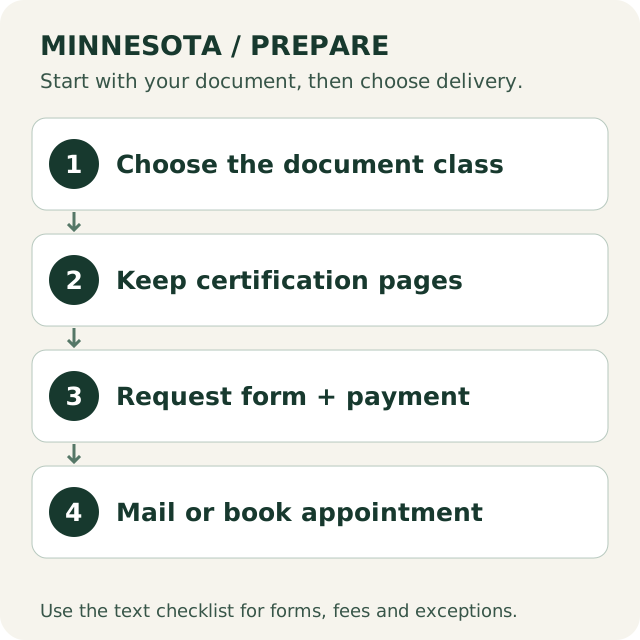
Start with the receiving office and the actual record
Write down the requested document, issuer, version, age, purpose, translation and delivery format. Ask whether an apostille is needed at all: an exemption or simpler accepted procedure can make it unnecessary. For Convention use, check the relationship covering the United States and destination, including territorial scope and objections, on the relevant use date. This guide explains Minnesota-origin routes; it is not an all-country acceptance catalogue. [HCCH-01: Articles 1–3,12–13; MN-01: FAQ General Information.]
HCCH-01 source
MN-01 source
Understand what the certificate proves
An apostille authenticates the official signature, the signer’s capacity and, where appropriate, the seal or stamp. It does not determine whether the document’s contents are true, a degree is recognized, a translation is accurate or a transaction is lawful. It also does not supply a missing court order or make an uncertified record an issuer-certified one. Those are different questions that the recipient or originating authority may still need answered. [HCCH-01: Articles 3 and5; MN-01: What is an Apostille? Original explanation of the consequence of limited authentication.]
HCCH-01 source
MN-01 source
Minnesota uses one state certificate even outside the Convention route
Since May 15, 2018, SOS says it issues a single Apostille for documents used outside the United States regardless of destination. Do not instruct a Minnesota customer to buy a separate differently named state certification solely because the destination is outside the Convention. The same Minnesota output does not create a treaty relationship: for a non-Convention destination, establish the recipient’s and relevant federal/consular authorities’ further requirements. A foreign shipping address alone is not a foreign-use requirement. [MN-01: FAQ General Information, Does the Minnesota Secretary of State issue an Apostille or Authentication Certificate?; FAQ Apostille Submitted by Mail; HCCH-01: Articles 1–3.]
MN-01 source
HCCH-01 source
Sort by the signature that needs authentication
Separate certified vital/county/court records, SOS-certified company records, school documents, BCA criminal-history letters and private notarized papers. The first two groups may already have an authenticatable official certification; the other groups can need a specific notarial preparation. Do not add the same notary cover sheet to every document. A court case located in Minnesota does not make a federal court document a Minnesota state-court record; an out-of-state school record follows its originating state’s instructions. [MN-01: Apostille Document Guide; FAQ Background Checks and School Documents; HCCH-01: Articles 1 and6. Federal/state distinction is original route analysis.]
MN-01 source
HCCH-01 source
Separate notarizing an application from notarizing the resulting record
You may need a notary to sign a mailed request for a birth certificate. That authenticates your application; it does not mean the resulting official certified birth certificate needs another notarization. SOS’s certified-record list expressly needs no additional notary act. This distinction prevents paying twice and protects the official record from an unnecessary extra statement. Use the specific issuer’s request instructions first, then the SOS document category. [MN-08: How to apply; MN-09: p. 1 signature block; MN-01: Apostille Document Guide, original certified documents.]
MN-08 source
MN-09 source
MN-01 source
Know which vital record you are buying
A certified birth or death certificate is issued on security paper; a noncertified informational record is a different product. MDH lists birth records from 1900 and death records from 1908 across vital-record offices, with older records directed to the county of occurrence. A verification that a record exists is not the certificate itself. Ordering the cheaper informational product does not satisfy an ordinary certified-certificate request, although it can have a specific role in the long-form package explained below. [MN-06: Birth records and amendments; Death records and amendments; availability footnotes; MN-08: Verification of birth.]
MN-06 source
MN-08 source
Check vital-record access before ordering
Hennepin’s current birth application requires the requester to identify an eligible relationship or legal basis and separates access to public and confidential records. Being able to see an index entry is not authority to obtain every certified record. Complete the applicable relationship boxes, supply the requested supporting authority, and leave the signature for the notary or county counter as instructed. A certified court order is different from a subpoena in the application’s court-order access categories. [MN-09: p. 1 requester and mandatory relationship categories 1–23.]
MN-09 source
A worked birth-certificate order through Hennepin County
For an eligible requester, open the county’s current two-page certified application, enter the birth/requester facts, choose the relationship basis, and complete the required notarization for a mail/drop-off order. Include a check or money order and use the application’s address: Hennepin County Vital Records Office, Hennepin County Government Center,300 South6th St,MC-678B,Minneapolis,MN55487-0678. Make the check payable to Hennepin County Treasurer. The current February 2026 form prices one certificate at $26 and extra copies in that purchase at $19 each. This is a public county option, not the address or payment for SOS. [MN-08: Mail or drop off; MN-09: pp. 1–2.]
MN-08 source
MN-09 source
Choose county birth-record timing with its actual conditions
Hennepin publishes regular preparation within three weeks of receipt; its faster one-week birth option requires dropping off the application/payment, an additional $20 and an Expedite marking. Most in-person copies can be issued when applying, subject to staffing; pre-1935 records can take longer. The faster fee excludes overnight return delivery. These are record-procurement options, checked October 25, 2026, not SOS apostille processing or promises that every Minnesota county offers the same service. [MN-08: Processing times; MN-09: p. 2 faster-processing row.]
MN-08 source
MN-09 source
Death certificates use a separate application and fee
Hennepin’s current page prices a certified death copy at $13, with $6 for extra copies; it lists Hennepin deaths from 1870 and other Minnesota counties from 1997. Its February 2026 application distinguishes certificates with or without cause of death, with the no-cause version limited to 1997 onward. For mail/fax, complete the required eligibility and notarized signature; in person, bring the unsigned form, identification and payment. For mail, send the application and check/money order payable to Hennepin County Treasurer to Vital Records Office, Hennepin County Government Center, 300 South 6th St, MC-678B, Minneapolis, MN 55487-0678. Its page publishes three-week regular and one-week faster preparation, with an extra $20/Expedite marking; mailing time is additional. [MN-10: Availability, Fees, Processing times and How to apply; MN-19: pp. 1–2.]
MN-10 source
MN-19 source
Long-form birth requests need an honest substitute explanation
Minnesota no longer issues a long-form birth certificate. MDH recommends a certified birth certificate, a noncertified birth record and its policy memo; for pre-2001 births, specifically request an image of the paper record. Explain this to the recipient before purchasing, because it decides whether the substitute answers its question. SOS says the certified certificate is one document, while the noncertified record and policy memo need appropriate Minnesota notarization before apostille; all three cannot be presented as one document. Do not staple them together and assume one $5 certificate covers everything. [MN-06: Long form birth certificates; MN-01: FAQ Vital Records, long-form question.]
MN-06 source
MN-01 source
Marriage certificates come from the county that filed the license
MDH does not record marriages or divorces. Its marriage-record guidance points to the county office that issued the marriage license; its linked Minnesota Official Marriage System can help locate the county. Order that county’s certified marriage certificate, not a keepsake, souvenir, blank license application or merely an index printout. SOS expressly excludes the souvenir certificate and accepts the certified Minnesota record. County procurement fees, forms and delivery options are separate from the $5 apostille. [MN-06: Marriage and divorce records; MN-01: FAQ Vital Records, marriage and keepsake questions.]
MN-06 source
MN-01 source
Court orders require the court’s certified product
Obtain a certified divorce decree or judgment from the Minnesota district court holding the proceeding, identify the case number and exact document, and use its copy-request procedure. The Judicial Branch distinguishes free plain copies, generally $14 certified copies, and generally $14 exemplified copies;$28 applies when both certified and exemplified are requested, unless fees are waived in the case. SOS lists certified decrees/judgments directly; exemplification is not a uniform extra prerequisite. Ask why an exemplified copy is required before buying one. Sealed/adoption/juvenile records may need access paperwork. A publicly downloadable plain copy is not the requested certified product. [MN-12: Overview, copy types and access limits; MN-01: Apostille Document Guide.]
MN-12 source
MN-01 source
Treat unfamiliar court electronic outputs as a named question
The court’s description allows an image of its seal on a certified copy, while SOS’s express electronic-notary rejection addresses printed notarized electronic documents. Those are not automatically the same product. For an electronically delivered court certification unlike the ordinary certified paper record, preserve the court’s full certification and ask SOS whether that exact output is accepted on paper or needs a different issuer-certified version. Do not apply the company-record print exception to all electronic court records, and do not convert the decree into a private copy statement without recipient evidence. [MN-12: certified-copy description; MN-01: FAQ Notarized Documents and Business Entity Records. Unresolved comparison, not an acceptance finding.]
MN-12 source
MN-01 source
School seals do not replace the required notarization
SOS says a Minnesota transcript bearing only a school official’s signature and registrar-applied school seal is insufficient: the transcript must be properly notarized by a Minnesota notary. Its rule covers K-12, college and university transcripts. A school’s sealed envelope will be opened by SOS to inspect the notarization. If the recipient requires a sealed transcript, plan with the registrar/recipient how it should be delivered after authentication rather than assuming the original seal can remain untouched. [MN-01: Apostille Document Guide, Transcripts; FAQ Minnesota School Documents.]
MN-01 source
Diploma original or copy is a recipient decision
SOS’s school FAQ permits properly notarized originals or photocopies of Minnesota diplomas and tells the requester to establish which the receiving country requires. That does not authorize misdescribing a copy as the original or establish that a student’s statement meets a recipient’s demand for a registrar-certified record. Obtain the school’s preparation instructions and the recipient’s exact version first. Out-of-state school records need the originating state’s process. [MN-01: FAQ Minnesota School Documents, diploma and out-of-state questions.]
MN-01 source
University of Minnesota gives a concrete school pathway
The Twin Cities Registrar offers appointment-only notarization of original transcripts, enrollment verifications and diplomas at One Stop in Bruininks Hall. Request notarization when requesting records; ask its office for paper transcripts/enrollment verification if needed. Its current guidance publishes two to three weeks for duplicate diplomas regardless of notarization or priority shipping. That production period comes before SOS. It also tells students to establish the complete requested set, possibly including course descriptions, so a later missing-record request does not restart procurement. This example is specific to UMN, not a statewide university service guarantee. [MN-11: Notarization; Notarize in person; Process documents at the same time; Duplicate diploma processing time.]
MN-11 source
Choose the correct company product
An official copy of filed articles, a certificate of good standing/existence and a private company resolution answer different questions. The SOS copies form says the original incorporation/organization certificate is part of the original filing; ordering good standing does not retrieve that document. Good standing addresses compliance with required filings/fees at issuance, not future compliance or every underlying business activity. Start with the exact recipient request and entity/file number. A private resolution or company power of attorney follows its required notarial route instead of becoming a filed-record copy. [MN-04: p. 1 copy/certificate descriptions and Which product questions; MN-01: certified company records and private documents.]
MN-04 source
MN-01 source
Order official company copies online or by mail
In Business Filings Online, search the entity, open Details, choose Order Copies, select the actual filings and choose Certified rather than Non-Certified. Online delivery is electronic; a paid certified copy includes a Certification of Record page. For mail, use the two-page Business Certificate/Copy Request Form with the entity’s Record Details/history printout and payment. The current form says copy/certificate orders are online or mail only, not in-person. SOS’s apostille FAQ allows mailing that copy request together with the Authentication Request Form and appropriate procurement plus apostille fees. [MN-03: How to Order Copies & Certificates Online steps 1–7; MN-04: p. 1 instructions; MN-01: FAQ Business Entity Records.]
MN-03 source
MN-04 source
MN-01 source
Print emailed SOS-certified company output exactly as instructed
This is a specific accepted paper presentation: SOS tells customers to print every filing and every Certification of Record page from its emailed certified copies, then mail them with the authentication form and fee. It separately permits printing an emailed good-standing/existence certificate for apostille. Preserve the complete issuer file and its certification; a free search printout or omitted certification page is a different product. This express exception does not mean any emailed PDF or electronic notarization can simply be printed and accepted. [MN-01: FAQ Business Entity Records, both Option 1 branches; MN-03: certified-copy explanation.]
MN-01 source
MN-03 source
Company procurement fees are separate from apostille
The current business form lists $3 per filing plus a $5 certification fee for a certified copy; a standalone good-standing or existence/registration certificate is $5. It distinguishes available certificate types by entity type. For a fictional one-filing certified-copy order, the listed procurement components are $3 + $5 = $8; adding one $5 apostille makes $13 before postage or optional assistance. For multiple filings, first establish how the actual order is certified and how many apostille certificates are needed; do not multiply by page count or assume one certification covers every independently required document. [MN-04: p. 1 fee table and entity-type table; MN-02: p. 1 $5 certificate fee. Arithmetic example is original analysis.]
MN-04 source
MN-02 source
Keep company delivery clocks distinct
The online ordering guidance says certificates are issued upon payment, later describing status-certificate delivery within 10–15 minutes, while some copy orders take 7–10 days. Its certificate download link lasts 90 days; save the issued file rather than relying on that link indefinitely. A mailed copy request is emailed only when the email is linked to an existing online account; otherwise the form says it is mailed. These are procurement/delivery facts, checked October 25, 2026, not completed apostille timing or a guarantee that an order immediately clears every review. [MN-03: ordering overview, delivery step 7 and certificate steps 3,11; MN-04: p. 2 electronic-delivery note.]
MN-03 source
MN-04 source
Private documents need the actual notarial act
Powers of attorney, consents and affidavits must be properly notarized by a Minnesota notary for this state route. An acknowledgment concerns execution; an oath/verification concerns a sworn statement. Follow the document’s lawful requirement and do not choose an act only because a foreign template contains a blank stamp space. The SOS office supplies apostilles, not notarial services, so arrange the needed act beforehand. Ask a bank, workplace, library or local notary about suitable low-cost service and availability; a mobile appointment is an optional convenience. [MN-01: FAQ Notarized Documents and no-notarial-services question; MN-13: subdivisions 1–3; MN-14: possible local providers.]
MN-01 source
MN-13 source
MN-14 source
Check the certificate, not just the stamp
The statute requires a contemporaneous signed/dated certificate, jurisdiction, officer title and notary commission-expiration information, with the required stamp and attachment for a tangible record. SOS’s apostille instructions additionally describe an English certificate and original wet signature for their paper submission. Attribute those English/wet-paper requirements to the agency’s procedure: section 358.65 itself also addresses electronic records and does not state a universal English-only rule in its listed elements. Select the proper statutory form or another legally sufficient form for the act; complete all facts accurately before submission. [MN-13: subdivisions 1–3,5–6; MN-01: Apostille Document Guide, Proper notarization; FAQ Notarized Documents.]
MN-13 source
MN-01 source
Verify the notary’s authority at the time of the act
Compare the notary’s commission name, signature/stamp and expiration details with the official record. SOS explains that the stamp name must match the commission and notes its renewal exception for continuing to use a still-unexpired stamp. Its notary-status tool shows current status, commission history and E/RON authority; it is a verification tool, not a promise to locate an available provider. A notary’s obligation to record a commission with the county is separate from requiring every customer to obtain county authentication for each document. [MN-01: Valid Minnesota Notary Commission/Notary Stamp; MN-14: status and history; MN-16: County Recording of Commission.]
MN-01 source
MN-14 source
MN-16 source
Identity-copy requests do not require mailing original IDs
The SOS FAQ instructs a Minnesota driver-license/ID copy or passport copy to be notarized as a true and correct copy and specifically warns against sending the original identity document. That authenticates the notarial copy act, not direct issuance by a passport authority. Establish that the recipient actually accepts this copy route and what information it requires. Keep an identity-copy request distinct from a request for a federally issued certified record. [MN-01: FAQ Driver Licenses/Identification; HCCH-01: Articles 1 and5; consequence explained by Notary Geek.]
MN-01 source
HCCH-01 source
Single-status requests can have different sources
SOS describes county no-marriage-record letters and signer-created sworn single-status statements as different routes. Its named Hennepin exception matters: that county’s Verification of No Marriage Record is not certified, so SOS says it needs proper Minnesota notarization. Do not assume a county letter is automatically certified, or that a search of one county proves no marriage anywhere. Obtain the recipient’s requested statement, geographic scope and time period, and describe accurately what the chosen document establishes. [MN-01: FAQ Vital Records, letter of Single Status; scope explanation is original analysis.]
MN-01 source
Minnesota criminal history and FBI history are not interchangeable
SOS requires a notarized BCA letter for the Minnesota criminal-history route and routes FBI checks to the U.S. Department of State because it cannot apostille that federal product. A public search printout, local police letter and BCA notarized result are distinct records. This check could not inspect current BCA procurement instructions because the linked DPS page was restricted/robots-blocked. Before purchasing a state check, ask BCA specifically for the notarized letter for apostille, current application/identity requirements, fee, submission/return and processing. No unverified BCA $15 price or address is adopted here. [MN-01: FAQ Background Checks/Criminal History Record; failed-retrieval note in source evidence.]
MN-01 source
Translations are separate documents when submitted for apostille
SOS does not provide translation services. Its vital-record translation FAQ requires appropriate Minnesota notarization with the notarial wording in English; the rest may be another language. It expressly treats an official certified birth record and its notarized translation as two documents receiving separate apostilles. First establish whether the recipient wants translation at all, by which authorized translator and whether the apostille itself must also be translated. State authentication of a translator’s notarial signature does not certify linguistic accuracy or replace the source record. [MN-01: FAQ Vital Records, translated certificate questions; FAQ Notarized Documents, other language; HCCH-01: Article 5.]
MN-01 source
HCCH-01 source
Use the actual authentication form and its fields
Download the one-page SOS Apostille Authentication Request Form linked here, revision July 26, 2024. It asks for name, contact/return address, optional company, email, document count, payment total, special instructions and an optional existing SOS client account. Leave the account blank if you have none; you do not need to invent an account number. Use special instructions for a different return destination and necessary explanation. The form does not show a destination-country field, despite the importance of obtaining destination instructions yourself; do not claim the state mandates a nonexistent field. [MN-02: p. 1 requester fields, client-account note, Special Instructions and Return Mail Address.]
MN-02 source
Count certificates before writing the payment
SOS charges $5 per apostille certificate. Three separately authenticated documents therefore mean $15 in SOS apostille charges, not $5 for an envelope or $5 for each sheet of a multipage certified record. The long-form and translation rules can create several separately submitted documents even when they relate to the same person. If a composite record has several certifications or an unusual attachment, establish the certificate count rather than inventing a universal per-signature/page rule. Issuer fees, notary fees and postage are different cost categories. [MN-02: p. 1 fee and document-count fields; MN-01: long-form and translation FAQs. Arithmetic and cost comparison are original analysis.]
MN-02 source
MN-01 source
Choose payment for the channel you use
For an apostille sent by mail, include a check or money order payable to MN Secretary of State. At an apostille appointment, SOS lists credit card, debit card, cash, check or money order. Do not import the broader business-copy form’s cash/client-account instructions as permission to mail cash for an ordinary apostille order; use the apostille-specific instructions. Keep a record of the check or money-order number because the status FAQ asks for it when locating a mailed request. [MN-01: How to Get an Apostille, Fees and Acceptable Payment by channel; FAQ Apostille Submitted by Mail; MN-02: payee and optional account field.]
MN-01 source
MN-02 source
Send the mail request to the current apostille office
Include the Minnesota certified or properly notarized documents, completed authentication form and fee. The address on both the current page and form is Minnesota Secretary of State,First National Bank Building, 332 Minnesota Street, Suite N201, Saint Paul, MN 55101. Do not substitute an old 60 Empire Drive address or the office’s separate elections/administration address. This is also the published appointment location, but mailing a packet does not book an appointment or create a counter-service commitment. [MN-01: By Mail and Appointments are conducted at; MN-02: p. 1 mailing block.]
MN-01 source
MN-02 source
Choose return service explicitly
SOS ordinarily returns documents to the form’s address unless another destination is specified. It offers regular USPS return at no charge without tracking, or permits an enclosed prepaid FedEx, USPS Priority Mail or UPS label for tracking. The form also permits a self-addressed stamped envelope or prepaid label with additional services. Put the intended return details on the form; do not rely on the fallback address on a check. Prepay the actual service you need and establish any international-carrier destination constraints. Faster postage moves the packet after processing; it does not buy priority in the state queue. [MN-01: By Mail, return note; General Information, urgent mail question; MN-02: p. 1 Return Mail Address.]
MN-01 source
MN-02 source
Appointments have a document limit and no walk-in substitute
Book the Apostille Authentication appointment type through the linked official scheduling instructions; slots become available fourteen days ahead. SOS says no walk-ins, allows another person to present the request, and accommodates up to ten documents per appointment. For more than ten, its FAQ says mail or drop them off with payment; do not assume a drop-off receives while-you-wait handling or arrange repeated bookings to evade the published limit. The business-filing appointment’s two-form limit is a different appointment category, not the apostille ten-document limit. [MN-01: FAQ In-Person Apostille Appointments; MN-05: booking steps and appointment types.]
MN-01 source
MN-05 source
Keep processing claims dated and bounded
Checked October 25, 2026, the reviewed SOS apostille page and request form do not publish a fixed numeric mail turnaround; the FAQ says requests are processed in receipt order. Overnight inbound/return delivery does not expedite that processing. If the deadline cannot tolerate queue uncertainty, compare an available appointment with mail, and use the published urgent-request email only for an actual scheduling question; an email is not acceptance or guaranteed acceleration. Add record production, correction, notary preparation and transport time separately. No old two-business-day brochure estimate or vendor expedite promise is adopted. [MN-01: FAQ General Information, urgent mail and appointments-booked questions; MN-02: p. 1.]
MN-01 source
MN-02 source
Read an MDH queue date as a historical snapshot
The official indexed MDH page, as of October 20, 2026, reports completed/mailed ordinary birth/death orders received by October 12 and expedited orders received by October 13. That is an observed received-through queue, not eight days promised for a new order and not the SOS queue. MDH’s general information favors a county visit for many routine records and does not offer its own in-person service; some specialized records remain MDH-only. Direct retrieval of the main index and several linked MDH PDFs failed in this research, so their bytes were not silently certified as reviewed. [MN-07: MDH PROCESSING TIMES and county/MDH distinction; MN-06: ordering overview and availability.]
MN-07 source
MN-06 source
RON validity, printed output and e-Apostille are three questions
Minnesota has a separate RON authorization regime, but the current SOS apostille FAQ rejects printed electronically notarized documents without appropriate further notarization. That is not a claim that Minnesota law prohibits RON. Hennepin accepts e-notarized vital-record applications, and SOS expressly permits printing its own emailed certified company outputs; those are distinct records and stages. HCCH’s implementation chart records Minnesota’s genuine e-Apostille pilot from March 15, 2024 (2024-03-15) through September 30, 2025 (2025-09-30), when the pilot ended. The chart states that e-Apostilles issued during that pilot remain legitimate and validly issued e-Apostilles, not tests. Do not reject a genuine historical pilot file merely because today’s ordinary instructions describe paper, or treat a scan as a pilot original. Current new e-Apostille issuance availability was not established here. [MN-17: authorization regime; MN-01: FAQ Notarized Documents and Business Entity Records; MN-08: application notarization; MN-10: application notarization; MN-20: p.10 Minnesota row and p.13 pilot-validity footnote.]
MN-17 source
MN-01 source
MN-08 source
MN-10 source
MN-20 source
Verify the issued certificate without treating the register as document approval
Minnesota’s public register asks for the apostille file number and issue date. SOS describes online verification for certificates issued May 15, 2018 or later; the register directs earlier or missing records back to the authority’s apostille instructions. Check that the result corresponds to the certificate and the authenticated official, not merely that some number exists. A successful lookup verifies issuance, not the truth of the birth, degree or transaction; a missing lookup alone does not establish fraud. Keep the stamped/stapled paper attachment intact and supply the physical packet if the recipient requires it. [MN-15: search fields, scope and no-record directions; MN-01: How is an apostille issued?; HCCH-01: Articles 4–7.]
MN-15 source
MN-01 source
HCCH-01 source
Repair the defective stage rather than adding another stamp
The request form flags absent/improper certificates, invalid or mismatched commissions, unnotarized private documents, insufficient fees, out-of-state origin and missing original signatures. Keep any rejection notice and identify the precise defect. An issuer-record error goes to its issuer; a notarial defect goes back to the notary; an omitted certification page or fee goes back through the application route. MDH’s birth-amendment process is separate from simply reordering a certificate. Do not rewrite a completed certificate yourself or attach another document to an issued apostille. Ask about resubmission and any new fee for the exact case; no blanket refund or free-rework rule was established. [MN-02: p. 1 rejection checklist; MN-18: Corrections and Amendments; MN-13: certificate/act requirements.]
MN-02 source
MN-18 source
MN-13 source
Fictional example: the electronically notarized request is not the authenticated record
Sofia abroad needs a certified Minnesota birth certificate. Hennepin’s published e-notarization allowance may let her complete its record-order application without traveling to Minnesota. She orders the eligible certified paper record and then submits that issuer-certified record to SOS with the authentication form and $5. She does not ask SOS to authenticate the printed remote application in place of the birth certificate. Her foreign recipient still decides whether the chosen record, age and translation meet its requirements. This is a teaching example, not a completed customer order or a promise that every foreign notarial certificate is accepted. [MN-08: mail/fax application; MN-01: certified vital-record branch; MN-02: fee; HCCH-01: Article 5.]
MN-08 source
MN-01 source
MN-02 source
HCCH-01 source
Fictional example: one school record can fail despite an impressive seal
Amir has a Minnesota university transcript with an embossed school seal, but no notarial certificate. SOS’s school rule requires notarization, so extra postage or a paid handler cannot repair the missing act. He asks the registrar for the needed notarized record and confirms whether the recipient accepts the envelope being opened for inspection. He uses the state form and pays the certificate fee only after preparation. The apostille authenticates the resulting signature route; it is not an independent assessment that his degree is accredited or equivalent abroad. [MN-01: Transcripts and School Documents; HCCH-01: Articles 3 and5. Fictional route analysis.]
MN-01 source
HCCH-01 source
Compare official direct options with optional assistance
Mail is available without hiring a service; an appointment can avoid mail transit when a suitable slot and prepared documents are available. A helper may present documents because SOS does not require the presenter to be the named subject. Optional paid help may be useful for understanding document categories, coordinating an issuer correction, checking a notarial certificate or managing a submission, but it does not change state eligibility, recipient requirements or the official queue. Obtain any provider’s actual scope, charges and terms separately. [MN-01: By Mail and FAQ In-Person, who may request; original comparison of public options.]
MN-01 source