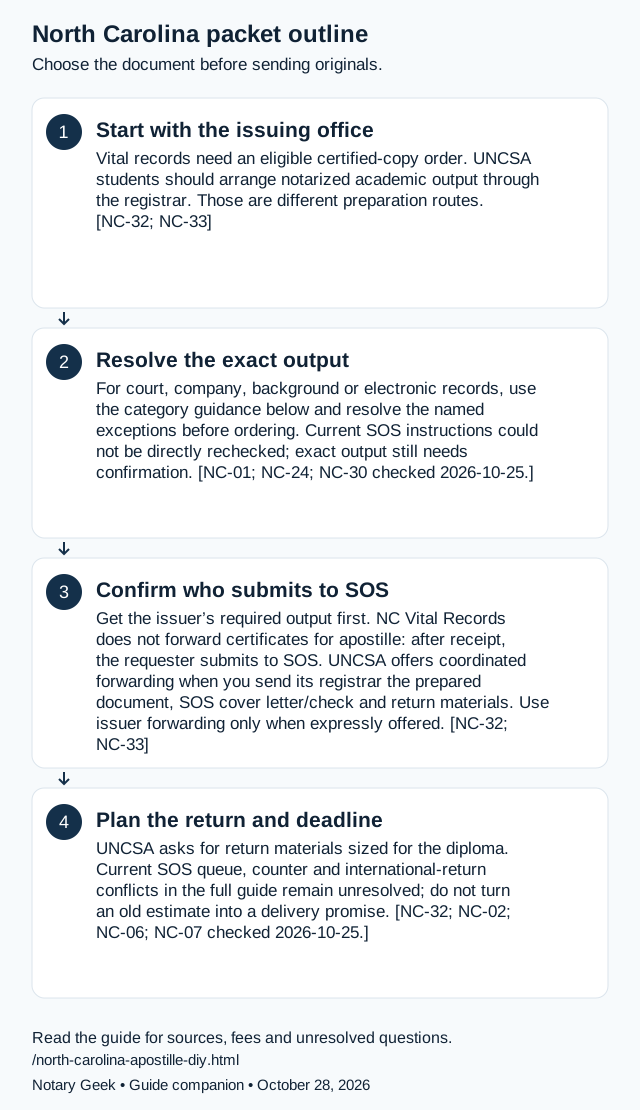
Begin with the record and its foreign purpose
Ask the receiving office for the exact record, issuer, version, age, purpose, translation and format it requires. An apostille authenticates the origin of a public document: the signature, official capacity and appropriate seal or stamp. It does not certify the truth of the contents, prove that a company is trustworthy, establish degree equivalency or make a private transaction lawful. Check whether authentication is needed at all; the Convention preserves exemptions and simpler arrangements. An otherwise genuine apostille does not replace the receiving office’s substantive requirements. [HCCH-01: Article 1; HCCH-02: Article 3; HCCH-03: Article 5; HCCH-06: paragraphs 21-28]
HCCH-01 source
HCCH-02 source
HCCH-03 source
HCCH-06 source
Choose apostille, authentication or authority for the actual destination
Use the HCCH status table to establish the applicable United States-destination relationship, including entry into force, objections and territorial application; a membership label alone is insufficient. North Carolina calls the Convention-route certificate an apostille. For a destination outside that route, its FAQ distinguishes an Authentication for NC government-issued records from an Authority certificate for NC-notarized papers; additional federal and consular steps may follow. Use the current federal instructions for that chain, not old addresses in a state manual. A foreign mailing address does not prove foreign document use, and an apostille is not intended to certify a domestic-only transaction. [HCCH-01: Article 1; HCCH-05: status-table notes; NC-02: kinds of authentications and improper-purpose questions; NC-03: intended use and further authentication]
HCCH-01 source
HCCH-05 source
NC-02 source
NC-03 source
Route by the official signature rather than the owner’s residence
The North Carolina Secretary of State authenticates qualifying North Carolina official or notarial signatures. A person living in Raleigh can still hold a Virginia birth record or a federal FBI report; residence does not turn either into a North Carolina official record. For an official out-of-state or foreign record, start with its issuing jurisdiction. For a federal record, use the appropriate federal authority. A newly signed private statement about a copy is a different document: notarizing it in North Carolina does not authenticate the original foreign or federal issuer. [NC-02: out-of-state question; NC-30: subsection (b); HCCH-03: Article 5; HCCH-11: authority designations]
NC-02 source
NC-30 source
HCCH-03 source
HCCH-11 source
Sort the documents before arranging a notary
Separate custodian-certified government records, court records, school records, filed company documents and privately signed papers. The SOS instructions exempt records from a Register of Deeds, Clerk of Superior Court, NC Vital Records and listed NC agencies from another notarization. Its list also includes Agriculture, DHHS, the Raleigh DMV office, Attorney General and Legislative Services. School records follow a different notarized route. Do not add a private notarial certificate to a custodian-certified vital record merely because the private document next to it needs one. No universal extra county-clerk certification step was identified in these NC instructions; follow the document-specific issuer route. [NC-01: Notarization of Document and School Diploma or Transcripts]
NC-01 source
Distinguish the event date from the certification date
North Carolina’s instructions require agency documents to be certified since April 1, 2000 because the office’s signature records do not cover earlier official signatures. That is not a rule that a person born before 2000 cannot obtain an apostille. A newly issued certified copy of an older birth record has a new certifying official’s signature. If you hold a certification signed before the cutoff, request a current certified copy from its lawful custodian rather than altering its date, copying the seal or asking an unrelated notary to adopt it. [NC-01: Time Requirement; NC-02: old-document/signatures-of-record question]
NC-01 source
NC-02 source
Recognize a certified vital record
Order a certified copy for legal foreign use. NC Vital Records describes the State Registrar’s signature, raised seal and certification on its official copy; its white-paper uncertified information copy is a different product and not a substitute for legal purposes. The SOS accepts certified certificate copies according to Vital Records’ apostille FAQ. The state retains the underlying record: the official certified copy supplied to you is the correct document to submit, even though a clerk may call it a copy. Vital Records does not itself obtain the apostille; after receiving the certificate, prepare the separate SOS request. [NC-10: FAQs on certified/uncertified copies and apostille]
NC-10 source
Choose the record custodian and establish eligibility
NC Vital Records lists holdings beginning in 1913 for births, 1930 for deaths, 1962 for marriages and 1958 for divorces. The Register of Deeds in the county of the event is another route for birth, death or marriage records; the county where you live is not automatically the county holding the event. The court clerk in the county of divorce supplies the court record. Certified vital records require an eligible requester, identity evidence and proof of relationship or legal entitlement when required. Sealed adoption records, amendments and delayed registrations use separate rules; ordering an apostille does not unlock a restricted original record. [NC-10: holdings, eligibility and county alternatives; NC-11: ordering channels; NC-16: divorce judgments]
NC-10 source
NC-11 source
NC-16 source
Understand online and telephone vital-record charges
The official state ordering page links its authorized VitalChek channel. Checked October 25, 2026, it lists a $24 search/first certificate if located, $13.95 online/telephone processing and $15 for each additional copy of the same certificate. Ordinary USPS delivery adds no shipping charge; the listed continental-US UPS overnight option adds $20. Thus one located record is $37.95 with ordinary delivery or $57.95 with that UPS option, before a separate apostille request. Overnight delivery begins after issuance; it does not make the record search overnight. The online/phone instructions require a street delivery address and signature for UPS; do not assume every reseller or advertised fast-service page is the state’s authorized channel. [NC-11: Online/Phone Order Processing Fees and shipping]
NC-11 source
Use the actual mail application for a birth certificate
For a regular birth-certificate mail order, use the application linked from the current state ordering page. Its February 2025 form asks for the record details, certified-copy choice, relationship/legal need, readable ID evidence, purpose and signature; it includes an Apostille/Authentication purpose choice. Its fee is $24 for the initial search/copy, $15 per additional same-record copy within the form’s limit, and $6 handling per application. That $6 is different from the $13.95 online/telephone fee. The form provides primary-photo-ID or two-secondary-ID routes and asks for proof where names or relationships require it. Follow the correct application for death, marriage or divorce rather than assuming a birth form serves every category. [NC-13: PDF pp.1-2; NC-11: Standard Ordering Forms]
NC-13 source
NC-11 source
Keep the vital-record payee and delivery conflict visible
The state’s Order a Certificate page, marked modified July 23, 2026, directs regular mailed certificate applications to NC Vital Records, ATTN: VC Certificate Orders, 1903 Mail Service Center, Raleigh, NC 27699-1900. Its linked birth form makes payment to VITALCHEK and accepts its stated check, money-order or card options. The Fees page, marked July 13, still describes mail payments to NC Vital Records and excludes personal checks. These instructions cannot honestly be merged into one universal payee rule. For the regular birth application follow the current page-linked form; for another service or a mismatching application obtain clarification before paying. The birth form says not to include a prepaid express envelope; select its delivery option instead. These are record-acquisition instructions, not SOS return-envelope instructions. [NC-11: Order by Mail; NC-12: Methods of Payment; NC-13: PDF p.2 payment/delivery]
NC-11 source
NC-12 source
NC-13 source
Compare the county and state counter alternatives
The state says most county birth/death/marriage records can be obtained the same day from the appropriate Register of Deeds; that is an alternative to the state queue, not a guarantee for every county or certificate. Check the county’s official requirements, eligibility, fee and hours. NC Vital Records’ own counter is appointment-only at the Cooper Memorial Health Building, 225 North McDowell Street, Raleigh, NC 27603-1382, for regular certificate purchases. Its stated appointment hours are weekdays 8:30 a.m.-3 p.m., with the final appointment at 2:30 p.m.; the published warning says slots may fill one or two months ahead. The listed in-person expedite charge is $15 in addition to the certificate charge. Amendments/adoptions are not ordinary counter purchases. [NC-10: county and appointment FAQs; NC-11: Order In Person; NC-12: fees; NC-14: physical address/service limits]
NC-10 source
NC-11 source
NC-12 source
NC-14 source
Read the vital-record queue using its actual clock
On October 25, 2026, the processing page displayed ten business days for regular births, two for deaths from 2022 onward, eleven for deaths from 1930-2021, and nine months for regular marriage and divorce certificates. Its clock runs from an order being keyed into the system to shipment, not from your envelope’s arrival or your payment being cashed to final delivery. Special amendments, paternity, adoptions and delayed registrations are separate. The currently linked birth application still warns of up to four months/120-plus days; that dated form and the current category table differ. Use the live category table as a dated planning observation, retain the form’s warning, and avoid promising an end-to-end date. Acquiring the record, obtaining the apostille and final delivery are three separate periods. [NC-15: Estimated Time for Regular Certificates; NC-13: PDF pp.1-2 processing warning; NC-12: payment caveat]
NC-15 source
NC-13 source
NC-12 source
Order the full divorce judgment when that is what is required
A vital-record divorce certificate or abstract records the event; it is not the complete court judgment with its terms. Ask the Clerk of Court in the county where the divorce was granted for the certified judgment when the recipient requires the decree itself. The Judicial Branch’s Obtaining Court Records page explains this route, and the SOS instructions list Clerk of Superior Court records as not needing another notarization. The same custodian principle applies to other court orders: a case-portal screenshot or privately notarized copy does not automatically replace the court’s certification. Identify the case and requested judgment and ask the clerk which certified or exemplified product is required; do not buy an unrelated vital abstract because it has a shorter form. [NC-16: divorce judgments and case records; NC-01: official-record exceptions]
NC-16 source
NC-01 source
Separate court-copy, certification and exemplification fees
The current 2026 miscellaneous court-cost chart lists $3 for a certificate under seal, $10 for exemplification, and copy preparation at $2 for the first page of each document plus $0.25 for each additional page. Those are distinct services; ask the clerk which apply to the requested record rather than quoting one flat total for every decree. The chart’s footnote about certain appointed indigent-defense attorneys is a limited exemption, not free certification for all applicants. These acquisition fees are additional to the SOS authentication fee and delivery. Court locations and procedures vary; no single statewide mail address or turnaround was established for all case records. [NC-17: PDF p.1 fee rows and p.2 footnote 4; NC-16: custodian instructions]
NC-17 source
NC-16 source
Prepare school records through the school
The SOS instructions require a North Carolina notary for records such as transcripts, report cards and diplomas from an NC university, college, community college or high school. A school seal applied by the registrar alone is not enough. Ask the registrar to prepare the actual record and the required notarized certification instead of asking an unrelated notary to declare that your education is valid. Decide with the recipient whether it requires the diploma, transcript, degree verification, original or acceptable copy. The notary authenticates the appropriate person’s act; neither that notarization nor the later apostille evaluates academic accreditation or foreign equivalency. [NC-01: School Diploma or Transcripts; NC-22: registrar processes; NC-23: registrar processes; HCCH-03: Article 5; HCCH-06: limited effect]
NC-01 source
NC-22 source
NC-23 source
HCCH-03 source
HCCH-06 source
Use a registrar’s published route without universalizing it
NC State’s Registration and Records and UNCSA’s Registrar both offer their own notarial preparation and can forward an appropriately prepared request to the SOS. Their instructions call for ordering a paper transcript for pickup/notarization and obtaining a replacement diploma if the original is missing. NC State directs diploma mail to Registration and Records, Campus Box 7313, Raleigh, NC 27695-7313; UNCSA uses its Registrar, 1533 South Main Street, Winston-Salem, NC 27127. Those addresses are for those schools only. Check your own school’s authorization, charges and document-release rules. NC State’s return-label advice uses the SOS as sender, while the SOS courier policy rejects certain SOS-billed labels; follow the receiving SOS policy and resolve that mismatch before sending. [NC-22: Mail-In Instructions; NC-23: Notary and Apostille Process/Mail-In Instructions; NC-06: Shipping Documents]
NC-22 source
NC-23 source
NC-06 source
Order filed company documents for authentication through the official route
Choose the actual product requested: certified articles or amendments, another filed document, or a Certificate of Existence describing entity status. Private bylaws and resolutions are not automatically filed public records. The SOS authentication FAQ gives a specific foreign-use company-document route: contact its Business Registration ordering service at 919-814-5400, choose menu option 4, identify the record and ask for a certified document to be authenticated. The office supplies the invoice and payment directions. Then send the invoice copy, authentication cover sheet, return arrangements and unpaid invoice amount if not already paid online. This guide explains the published route; no call, order or payment was made during research. [NC-02: certified copy from Secretary of State files; NC-24: order categories]
NC-02 source
NC-24 source
Distinguish electronic certified company records from free images
The ordinary online company-order page separates plain copies from electronic certified documents and permits saving/printing the certified output. That does not itself establish how every printed electronic certificate will be admitted to the paper apostille process. The authentication FAQ’s coordinated certified-record/invoice route avoids treating a free search image as certified. If you already bought electronic output, preserve its original file and verification information and ask whether that exact output is suitable before reprinting, reformatting or privately notarizing it. A company in merged, converted, dissolved or other non-current status may show a Dirty document invoice status because a custom certificate is required; it is not proof the underlying company record is fraudulent. [NC-24: Lower Section; NC-25: Dirty document and image-request questions; NC-02: coordinated company-order route]
NC-24 source
NC-25 source
NC-02 source
Keep company-record charges separate from apostille charges
For corporation records under Chapter 55, the statute lists a paper Certificate of Existence/Authorization application at $15 and electronic at $10; copying/comparing is $1 per page with paper certification $15 or electronic certification $10. These are statutory corporation-record categories, not a claim that all entity types and custom products have one identical total. The authentication FAQ tells foreign-use applicants to obtain the exact invoice for the requested record and authentication. Reconcile that invoice before paying, and do not pay it again if already paid online. The separate ordinary apostille/authentication unit is $10 per document; shipping and any school/notary charges are additional. [NC-29: subsections (a)(25)-(25a), (c)(1)-(3); NC-02: invoice procedure and authentication fees]
NC-29 source
NC-02 source
Prepare privately signed papers before submitting
A power of attorney, employment declaration or private corporate authorization normally follows the signer/notarial route, rather than the certified public-record route. Obtain the act and wording actually required for that document; the SOS says it cannot notarize a paper it will authenticate. North Carolina law permits acknowledgments, oaths/affirmations and verifications/proofs, with requirements for the notary’s attestation. The notary is not a general legal adviser and cannot determine the needed certificate for an otherwise unspecified document merely because the signer wants an apostille. Resolve the intended act with the document’s lawful instructions, recipient or appropriate legal adviser before signing. [NC-01: Notarization of Document; NC-02: counter notarization; NC-27: subsections (a)-(b), (k), (m)]
NC-01 source
NC-02 source
NC-27 source
Check the actual notarial act and certificate
For an acknowledgment, the signer acknowledges signing; for an oath or affirmation, the signer certifies the truth under oath/affirmation. Those acts are not interchangeable just because both use a seal. North Carolina’s certificate provisions identify the appearing person, applicable act/date and notary signature/seal and commission information, with act-specific details. Before submission, check that the person and document match, the certificate is complete and the notary’s signature, printed name, seal and commission expiration are legible. A stamp alone is not the act. A notary’s statement of representative capacity also does not independently prove the signer’s corporate authority: the statute assigns that representation to the signer. [NC-27: subsection (b); NC-28: subsections (b), (d), (h)]
NC-27 source
NC-28 source
Understand what a true-copy statement can and cannot do
The SOS authentication instructions describe a signer’s notarized true-copy affidavit for certain North Carolina document copies. Its notary guidance separately says NC notaries cannot themselves certify copies; for a permissible non-vital document the person may make a sworn copy statement and have the oath notarized. These are different propositions: the signer’s declaration is not the custodian’s certified vital or court record. The authentication page also refers to acknowledgment of the signer’s signature, while the newsletter describes an oath/jurat; an acknowledgment alone does not establish that an oath occurred. Identify the actual statement and certificate, lawfully choose the act and establish recipient acceptance. Do not use generic copy wording to bypass a restricted public-record route or to claim authentication of a different issuer. [NC-01: True Copy Affidavit/Notarization of Document; NC-26: copy-certification answer; NC-27: permitted acts; HCCH-03: Article 5]
NC-01 source
NC-26 source
NC-27 source
HCCH-03 source
Choose the right criminal-background product
A $25 certified name search through one county’s Superior Court Clerk covers that county, not the whole state or country. The Judicial Branch links AOC-CR-314 for that request and distinguishes it from a noncertified self-service search. A North Carolina SBI personal fingerprint review is a different statewide product costing $14; the federal FBI Identity History Summary is separate again. Ask the recipient which geography, identity method and certification it actually requires before paying. Neither a private internet search nor an apostille broadens a report’s underlying coverage. Do not assume that a local court search meets an FBI requirement or that a notarized copy of a federal report changes federal origin. [NC-18: Individuals/Single County/SBI; NC-19: state versus national check; HCCH-03: Article 5]
NC-18 source
NC-19 source
HCCH-03 source
Request the SBI fingerprint review with the proper physical packet
Use the SBI’s linked Right to Review form and follow its instructions for complete legible fingerprints on the required card. Its instructions call for fingerprints taken by law enforcement or another authorized official, with the fingerprint official’s identity check; the form says the Social Security number is optional. The application, fingerprint card and $14 per request go by US Mail only to NC State Bureau of Investigation, Criminal Information and Identification Section, Attention: Applicant Unit-Right to Review, 3320 Garner Road, Raleigh, NC 27610. Use a certified check or money order payable to NC State Bureau of Investigation; cash, personal/business checks and cards are not its payment method. Do not fold the fingerprint card. No in-person, FedEx or UPS submission is accepted under that form; the SOS courier route does not change SBI acquisition rules. [NC-21: PDF pp.1-5, especially pp.4-5; NC-19: fee]
NC-21 source
NC-19 source
Ask for the overseas SBI letter and allow for source correction
The SBI FAQ instructs an applicant needing a notarized letter for overseas/VISA use to identify that purpose on the request. A routine personal-review response is not automatically the specially prepared overseas package. SBI returns results to the individual by first-class US Mail, not a third-party delivery service. Its FAQ has conflicting approximate seven-business-day and up-to-twenty-business-day statements; no separate expedited service is offered. Plan using the longer published warning and return-mail time rather than promising a week. Bad or incomplete fingerprints may require a new set. If the criminal history is wrong, use the written exception/challenge process in the application; do not edit the report or expect the apostille to correct it. [NC-20: overseas/VISA, mail, expedite and timing questions; NC-21: PDF pp.3-5]
NC-20 source
NC-21 source
Provide the English translation North Carolina asks for
For a non-English document, the SOS instructions call for a certified or notarized English translation. Its FAQ says the translation must bear a wet/original signature under a change described only as late 2024; an exact effective date was not supplied. The older manual sometimes says certified and notarized, rather than or. Resolve the actual category-specific presentation when those words affect your packet; do not silently treat a scan of a translator’s signature as an original. The recipient may independently require a different target language, translator qualification or separate authentication. An apostille on a translator’s notarial certificate authenticates that public/notarial origin, not translation accuracy or the original foreign issuer. [NC-01: Document Needs to be in English; NC-02: foreign-language question; NC-08: translation passage; HCCH-09: paragraphs 186-188]
NC-01 source
NC-02 source
NC-08 source
HCCH-09 source
Complete the authentication cover letter with actionable information
Use the official Cover Letters and Templates link and the current English/Spanish cover-letter PDF. The indexed form asks for contact name, email, address, telephone, destination country for each document, special instructions, payment calculation and return method. Include the actual foreign destination rather than guessing from a shipping address. List third-party return instructions clearly if using an authorized recipient. The form index and PDF were blocked from direct retrieval in this research; fields were checked against official indexed form text and issuer links, so visual PDF completeness is not claimed. Download the live official form before filing; compare its current fields and instructions with this dated guide. [NC-04: form index; NC-05: indexed contact/destination/payment/return fields; NC-02: complete-request question]
NC-04 source
NC-05 source
NC-02 source
Count documents and the adoption-only duplicate exception
Ordinary apostille, Authentication and Authority processing is $10 per document, including non-adoption duplicates. For adoption-related duplicate originals submitted at the same time as the first original, the first is $10 and each duplicate original is $5. Three eligible original copies of the same adoption record submitted together therefore cost $20, while three ordinary non-adoption documents cost $30. A photocopy is not an additional duplicate original for this discount, and requesting a later original separately returns it to the $10 rate. Do not generalize this exception into a same-notary or all-purpose volume discount. These units are per document, not per page. [NC-02: fee question; NC-09: Copies of the same Document]
NC-02 source
NC-09 source
Make the SOS packet complete and pay the right office
The published submission checklist is the original documents with their certifications, completed cover letter, correct SOS fee and return envelope or prepaid carrier label, plus the required English translation where applicable. Check or money order is the published ordinary submission payment method; make it payable to North Carolina Secretary of State. The coordinated company-record procedure also permits its invoiced online payment and requires a business/personal check to include address and phone, excluding starter/counter checks. Do not apply VitalChek’s payee, SBI’s payment restrictions or an unrelated online corporate filing checkout to every SOS authentication request. Complete any private notarization beforehand and retain the check/order and outbound tracking references. [NC-01: Submission of Documents/Payment; NC-02: complete-request and company invoice questions; NC-05: indexed payment choices]
NC-01 source
NC-02 source
NC-05 source
Use different addresses for USPS and physical delivery
For the SOS authentication packet sent by USPS use Authentication Office, NC Secretary of State, PO Box 29622, Raleigh, NC 27626-0622. For commercial courier or hand delivery use Authentication Office, NC Secretary of State, 2 South Salisbury Street, Raleigh, NC 27601-2903, as printed in the official main contact block and cover-letter text. One FAQ appointment answer instead prints 27602; do not silently present both as equivalent ZIP codes. Use the full principal contact/form address and verify any carrier-address mismatch before shipment. These are not the VitalChek record-acquisition or SBI fingerprint addresses. [NC-02: main address block and appointment answer; NC-05: indexed address blocks; NC-06: location]
NC-02 source
NC-05 source
NC-06 source
Treat hand delivery as a submission option rather than a same-day promise
The current indexed SOS FAQ says appointments are no longer taken and documents may be brought in without an appointment. Its February 20, 2024 manual still describes appointments and same-day pickup after a morning cutoff. Those dated instructions should not be republished as a current guarantee. The FAQ says hand-delivered requests are generally faster and sends readers to the current front page for timing. Check the office’s actual public opening/closure and pickup instructions before traveling; no current universal counter-hour or same-day guarantee was independently established from the accessible sources. The Registrar’s appointment for school notarization and the Vital Records appointment are separate offices and do not reserve an SOS counter slot. [NC-02: appointments and hand-delivery questions; NC-08: dated appointment passage; NC-23: registrar process; NC-14: Vital Records appointments]
NC-02 source
NC-08 source
NC-23 source
NC-14 source
Read the published SOS estimate with its evidence limit
The official Business Registration overview’s search-index text retrieved October 25, 2026 displayed Authentications 10-15 business days. Its publication/effective date and a successful direct live-page read were not established here. The FAQ says mailed requests generally take five business days longer than hand-delivered requests and instructs readers to check the front page. Do not turn these statements into a guaranteed fifteen-day total, automatically add five days to an already channel-unspecified banner, or substitute the old manual’s same-day claim. Record acquisition, incomplete-packet correction, holidays and two-way shipping remain additional. For a documented emergency, the SOS says it will assess evidence and decide whether expedited processing is justified; it does not promise it for every deadline. [NC-07: Turn-Around Times; NC-02: mail/hand-delivery questions; NC-01: Emergencies; NC-09: Emergencies]
NC-07 source
NC-02 source
NC-01 source
NC-09 source
Arrange a valid domestic return and the required pickup
The SOS asks for a self-addressed stamped envelope or a computer-generated prepaid carrier label, not handwriting or an account number alone. Its FAQ/policy says the customer’s name and address should be sender and recipient and rejects labels that make the SOS the billable sender. If no usable prepaid return is supplied, ordinary US mail is the fallback. The published courier distinction matters: routine UPS/FedEx air pickup differs from ground service, for which the office notifies the contact and the customer arranges pickup. DHL has no daily scheduled pickup under the published policy. These are public agency instructions, not a recommendation of a particular carrier or private service method. The agency cannot locate an envelope after it leaves its custody. [NC-06: Shipping Documents/Ground Pick-Ups; NC-02: return labels and courier questions]
NC-06 source
NC-02 source
Check the limited international return option instead of assuming DHL
The SOS Courier Policies say it no longer uses third-party couriers such as UPS, FedEx or DHL to return documents abroad; its FAQ specifically permits prepaid USPS Express Priority international return. The Authentication/Authority instructions separately say to provide a US return address and omit that postal exception. Preserve the distinction and verify the exact international USPS product and usable label before relying on direct overseas return. A US return recipient is another arrangement to establish in advance; subsequent international delivery is separate. Do not send an international commercial-courier label expecting the state to treat it as a permitted option. The fact that you used that carrier to deliver a packet to Raleigh does not establish the reverse international route. [NC-06: Mailing to Foreign Jurisdictions; NC-02: send-to-another-country question; NC-03: Submission of Documents]
NC-06 source
NC-02 source
NC-03 source
Separate electronic or remote notarization from apostille output
The SOS FAQ says it does not do online authentications and its ordinary request instructions describe physical originals and mail/hand delivery. That is a submission/output observation, not proof that every lawful electronic or remote notarial act is invalid or every possible paper conversion is accepted. Identify the actual notary, act date, legal authority, original electronic file and proposed submission format before buying a service. Current SOS footer text discusses an emergency-video extension and the first remote-provider licence as a condition; that notice alone does not establish a particular platform’s current admission. No true NC e-Apostille issuance capability or universal RON-to-paper apostille method was verified here. Keep those questions open instead of marking e-Apostille false or promising online completion. [NC-02: online-authentication question; NC-07: footer notice; NC-30: signature restrictions; HCCH-10: electronic/conversion discussion]
NC-02 source
NC-07 source
NC-30 source
HCCH-10 source
Inspect the finished packet and verify the certificate at its source
Compare the apostille number, date, official name/capacity and document association with the record you submitted; keep the attachment intact. HCCH’s e-APP implementation chart lists a North Carolina Secretary of State e-Register on PDF page 10 and links a legacy verification address. That link could not be reached during this source review. The chart warns that Party-provided information may be delayed, so its listing does not establish that the portal works today. Its separate e-Register and e-Apostille columns also must not be collapsed: a reported verification register does not by itself prove electronic issuance. When the listed portal is unavailable, ask the SOS Authentication Office to check the certificate particulars against its register. Article 7 supports that issuer check without requiring a publicly searchable website. A business-certificate search or notary-commission search is not automatically the apostille register, and a register match does not establish substantive acceptance. [NC-31: PDF p.10 North Carolina row/link annotation and p.1 footnote 1; HCCH-04: Article 7; HCCH-07: attachment; NC-02: official contact; NC-30: subsection (c)]
NC-31 source
HCCH-04 source
HCCH-07 source
NC-02 source
NC-30 source
Fix the named rejection and preserve the appeal distinction
Read the actual rejection or denial letter. The SOS FAQ names wrong origin, defective notarization, absent English translation and improper purpose among reasons; a notary stamp alone does not compel issuance. G.S. 66-274 also states limitations on authenticating foreign or reproduced seals/signatures and improper-purpose requests, and prevents the Secretary from certifying legal validity in another jurisdiction. Correct the source record through its custodian, or arrange a lawful new/corrected notarial act, instead of editing the completed certificate or adding a stamp yourself. A formal denial has its own appeal instructions; the FAQ directs a contested-case petition to the Office of Administrative Hearings. Follow the letter and current tribunal rules rather than copying old personal names, addresses or assuming a universal appeal deadline from this guide. [NC-02: Not Authenticated; NC-30: subsections (a)-(c)]
NC-02 source
NC-30 source
Distinguish refund, rework and recipient refusal
The SOS FAQ permits asking for a refund when the authentication has not been processed and the request falls within 45 consecutive days after processing fees were received. The process page separately describes an unprocessed rejected $10 authentication refund on request. Neither establishes that an issued certificate will be refunded because a recipient wants a different document. Obtain the receiving office’s written reason and distinguish a defective apostille, insufficient source record, missing translation and substantive refusal. A new record or request may be necessary; no automatic reissue or fee waiver is promised here. Private notary, record-acquisition and carrier charges are separate from the SOS’s refund policy. [NC-02: refund and rejection questions; NC-01: Processing Fee refund exception; HCCH-06: limited effect; HCCH-08: refusal/recovery]
NC-02 source
NC-01 source
HCCH-06 source
HCCH-08 source
Worked example: an older birth event with a new certificate
Fictional example: Elena was born in North Carolina in 1988 and needs a certified birth record abroad. She first checks the recipient’s exact record/translation requirement and the applicable Convention relationship. A new custodian-certified copy, with a current certifying signature, avoids confusing the 1988 event with the April 2000 signature cutoff. She chooses the eligible county or state acquisition channel, compares that channel’s fees and queue, then sends the separate $10 SOS request with cover letter and return arrangement. She does not pay a local notary to certify a photocopy of her birth certificate, and she does not assume the VitalChek record-delivery order includes an apostille. This teaches the route; it is not a real order or delivery estimate. [NC-01: Time Requirement/official-record exception; NC-10: apostille FAQ; NC-11: acquisition; NC-13: birth application; NC-02: fees]
NC-01 source
NC-10 source
NC-11 source
NC-13 source
NC-02 source
Worked example: a diploma and the missing notarial prerequisite
Fictional example: Malik receives a North Carolina university diploma bearing a registrar’s seal, but no notarized certification, and the foreign university requests an apostille. The school seal does not satisfy the SOS school-record instruction. Malik asks the issuing registrar to prepare the appropriate notarized original or permitted school-certified copy, obtains the correct request documents and separate $10 SOS fee, and plans return under the SOS policy. He keeps educational-equivalency questions with the recipient rather than asking the notary to verify his degree’s value. If the school’s old shipping handout conflicts with current SOS billing or overseas-return rules, he resolves that specific mismatch before sending the packet. [NC-01: School Diploma or Transcripts; NC-22: registrar routes; NC-23: registrar routes; NC-06: return policy; HCCH-06: non-effects]
NC-01 source
NC-22 source
NC-23 source
NC-06 source
HCCH-06 source
Choose direct, local or managed help for a defined task
The direct official route is usable without purchasing Notary Geek service. A local bank, credit union, employer or neighborhood notary can be worth checking for a simple lawful wet-ink act, with price/availability established in advance; a registrar or record custodian may be the correct preparer instead. Direct official ordering can solve the record need more cheaply than an unnecessary private copy statement. Optional assistance may be useful for a defined source question, document preparation issue or practical submission barrier, and managed handling remains an optional separately agreed service. Optional assistance must follow eligibility requirements and carries no guarantee of state processing or recipient acceptance. [NC-01: preparation channels; NC-11: direct ordering; NC-22: issuer services; NC-23: issuer services; HCCH-06: limits]
NC-01 source
NC-11 source
NC-22 source
NC-23 source
HCCH-06 source